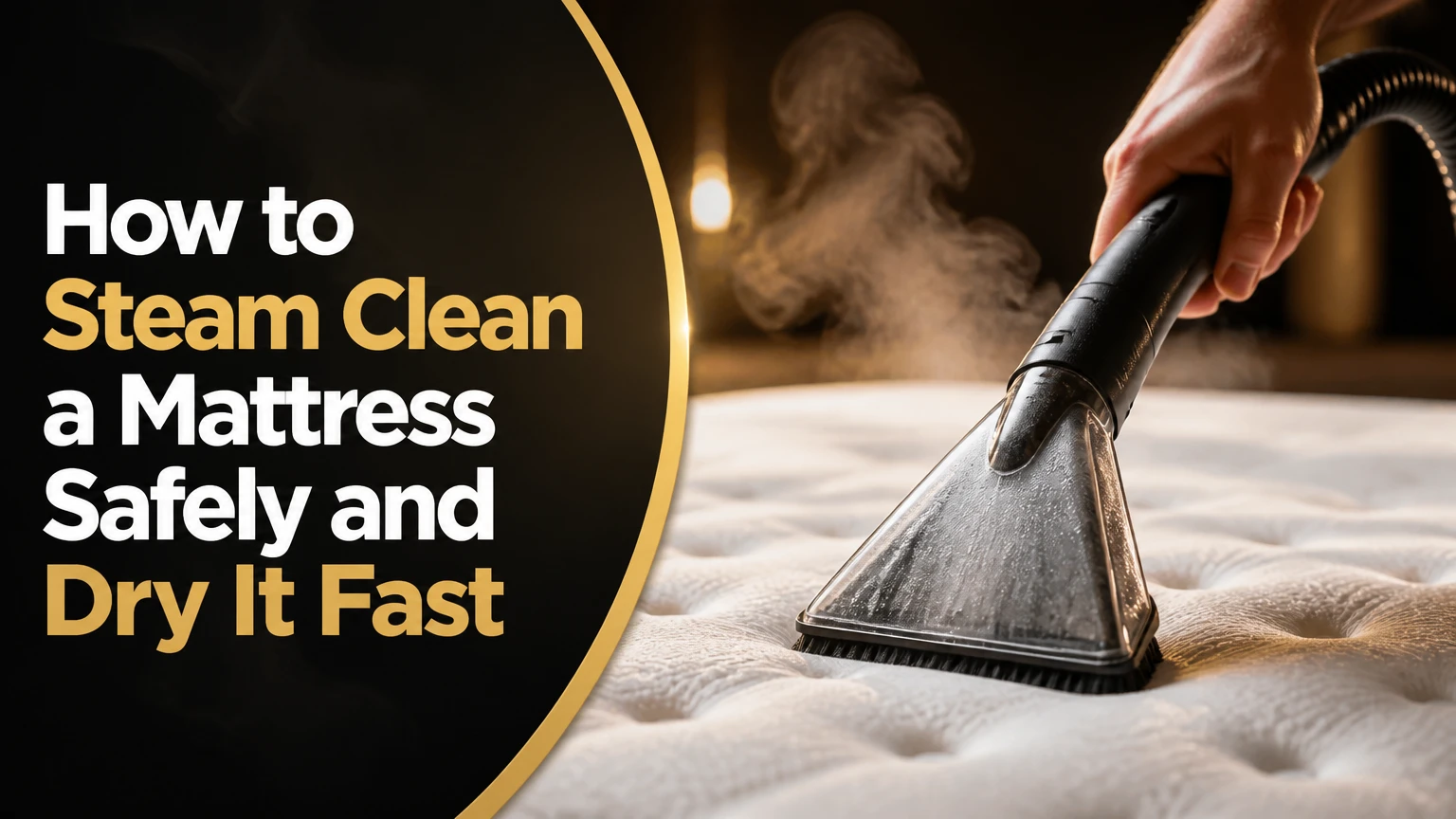
To steam clean a mattress, strip and vacuum it, spot-treat compatible stains, test a hidden area, then make slow passes with a dry-vapor steamer while limiting moisture. Keep the mattress uncovered with strong airflow until fully dry, usually 4-8 hours. Always check the care label because some foam, latex, and heated mattresses prohibit steam.
Key Facts at a Glance
Dry-vapor steam contains less liquid water than a carpet extractor, but it can still damage a mattress if held in one place.
A boiler temperature does not prove that the mattress surface reached a sanitizing temperature.
Steam can reduce exposed dust mites and microorganisms, but it does not remove all allergens or solve every bed bug infestation.
Vacuuming must come before steaming because heat and moisture can turn loose soil into a harder-to-remove residue.
A mattress should remain uncovered until the surface, seams, and underside are completely dry.
Memory foam, latex, pillow tops, adhesives, and electric mattress components require manufacturer-specific precautions.
Is Steam Cleaning Safe for a Mattress?
Steam cleaning is generally safe for a compatible, fabric-covered innerspring mattress when the operator uses short, moving passes and prevents saturation. Steam is not automatically safe for every mattress: concentrated heat can deform foam, loosen adhesives, shrink fabric, damage electronics, or invalidate a warranty.
A mattress can absorb moisture even when the surface looks nearly dry. The cover, quilting, batting, foam, and border seams dry at different rates, so a dry-feeling top does not prove that the interior is dry. Humidity above about 60%, poor ventilation, or placing bedding back too soon increases the risk of a persistent musty odor.
Check four things before using a steamer:
- Read the mattress care label and warranty instructions.
- Identify the construction: innerspring, hybrid, memory foam, latex, pillow top, or electric.
- Look for existing mold, flood damage, fiberglass warnings, or exposed electrical parts.
- Test steam on a concealed seam using the lowest effective exposure.
Do not steam a mattress with visible mold, sewage contamination, extensive flood damage, or an infestation requiring professional pest control. Cleaning cannot reliably make those mattresses hygienic.
How Does Mattress Steam Cleaning Work?
A dry-vapor steamer heats water in a boiler and delivers hot vapor through a nozzle or fabric-covered upholstery head. The heat loosens body oils and reduces exposed microorganisms, while the relatively small water content limits wetting compared with hot-water extraction.
“Dry steam” is a technical description of vapor quality, not a promise that the mattress will stay dry. Consumer steamers may spit condensed water during startup, when the tank is overfilled, or when the hose rests in a cold position. That liquid water is the part most likely to create over-wetting.
Boiler ratings also require careful interpretation. A machine may advertise 212-320°F inside the boiler, while the mattress surface receives less heat after vapor travels through a hose, attachment, and cloth pad. Pressure, nozzle distance, pass speed, and surface temperature all affect the result. PSI alone cannot establish sanitation.
The Environmental Protection Agency identifies steam as one possible bed bug control tool, but steam treatment requires direct contact and careful application. Heat must reach the insect or egg, not merely the air above the mattress.
Which Steamer Should You Use?
Use a dry-vapor cleaner with a controllable upholstery attachment, steady vapor output, and a cloth cover rather than a small nozzle held against the fabric. A handheld unit can refresh a surface, but a professional-grade vapor machine offers better temperature stability and less condensate when operated correctly.
| Equipment type | Typical price or rental | Mattress use | Main limitation |
|---|---|---|---|
| Handheld vapor steamer | $40-$150 purchase | Small surface areas and light refreshing | Small tank, uneven output, more spitting |
| Canister dry-vapor steamer | $150-$800 purchase | Whole compatible mattress, controlled passes | Higher cost and operator learning curve |
| Hot-water extractor | $30-$60 daily rental | Heavy liquid stains and soil removal | Adds substantial water and needs longer drying |
| Professional mattress service | $80-$250 per mattress | Delicate, large, or heavily soiled mattresses | Service quality and method vary by provider |
Distilled water can reduce mineral deposits in many steamers, but the machine manual takes priority. Some manufacturers specify filtered or tap water, and using the wrong water can damage the boiler or void support.
An upholstery head covered with a clean microfiber pad moderates direct heat and collects loosened soil. Replace the pad when it becomes visibly dirty. Reusing a saturated pad transfers residue across the mattress.
What Specifications Matter Most?
Look for adjustable vapor flow, a refillable or sufficiently large tank, a pressure gauge if supplied by the manufacturer, a textile-safe upholstery tool, and a hose that does not release large droplets. A claimed 40-60 PSI range is not a universal mattress requirement; controlled moisture and correct technique matter more than the highest pressure number.
For bed bug work, the EPA recommends a commercial steamer with a minimum capacity of at least 1 gallon and a nozzle that produces a broad vapor flow, according to its bed bug control guidance. Follow the current EPA instructions and the equipment manufacturer’s operating limits rather than relying on a boiler label alone.
Before You Start: Time, Tools, and Safety
Plan 30-60 minutes of active work for a Twin or Queen mattress and 4-8 hours of uncovered drying under ordinary indoor conditions. A thick pillow-top, high humidity, or a machine that emits excess water can extend drying to 12-24 hours.
| Requirement | Typical amount or setting | Why it matters |
|---|---|---|
| Active cleaning time | 30-60 minutes | Covers vacuuming, treatment, steaming, and inspection |
| Drying time | 4-8 hours | Requires airflow and an uncovered mattress |
| Distilled or approved water | 0.5-1.5 gallons | Depends on tank size and machine output |
| Microfiber pads | 2-4 clean pads | Prevents soil transfer during passes |
| Dry vacuuming | 10-20 minutes | Removes hair, skin flakes, and loose dust |
| Air movement | 1-2 floor fans | Moves humid air away from the mattress |
You will need a vacuum with an upholstery tool, the steamer and approved attachment, microfiber cloths, a compatible stain product, clean towels, a fan, and optionally a dehumidifier. Keep a thermometer or moisture meter available if the mattress is valuable or thick.
Disconnect an electric blanket, heated mattress pad, massage base, or adjustable-bed power system before cleaning. Never steam a control, cable, connector, or exposed motor. Remove the mattress from a damp floor and protect nearby wood or laminate from condensate.
How to Steam Clean a Mattress: Seven Steps
Step 1: Remove and Wash the Bedding
Remove sheets, blankets, pillows, mattress pads, and protectors before cleaning the mattress. Wash washable bedding at the hottest temperature allowed by each care label, then dry it completely on the permitted setting.
For dust mite reduction, a hot dryer cycle is often more practical than assuming every fabric tolerates a very hot wash. The American Academy of Allergy, Asthma & Immunology recommends encasing mattresses and pillows and washing bedding regularly in hot water as part of allergen control.
Inspect the protector. A waterproof protector with cracked polyurethane, trapped odor, or visible contamination may need replacement rather than steaming. Do not put a protector back on until both the protector and mattress are dry.
Success checkpoint: The mattress surface, seams, and underside are exposed, and all removable bedding is clean and dry.
Common mistake: Leaving a thin pad on the mattress, which blocks heat and hides damp areas.
Step 2: Vacuum Every Surface
Vacuum the top, sides, seams, handles, tufts, piping, and underside with an upholstery tool. Use slow overlapping strokes, then make a second pass along the edge where dead skin, hair, and dust collect.
A sealed vacuum with a HEPA filter can reduce the amount of fine material returned to room air, although a HEPA vacuum does not sterilize the mattress. Empty or replace the vacuum bag outdoors if possible, especially when cleaning an allergy-sensitive bedroom.
Do not sprinkle baking soda before vacuuming. Powder can clog some vacuum filters, and it does not replace mechanical removal of embedded lint or skin debris.
Success checkpoint: No visible hair, loose powder, or crumbs remain around seams and tufting.
Common mistake: Using the strongest suction directly on a loose-knit cover, which can stretch the fabric or pull threads.
Step 3: Treat Compatible Stains Before Steaming
Identify the stain before applying cleaner. Use an enzyme product for fresh urine or other protein-rich organic residue, a small amount of upholstery detergent for general soil, and cold-water blotting for blood unless the care label says otherwise.
Apply cleaner to a cloth or lightly mist only the stained area. Avoid soaking the foam. Allow the product to dwell according to its label, often 5-15 minutes, then blot from the outside toward the center.
Heat can set some protein stains, particularly blood and certain dyes. Steam is better for loosening residue and reducing odor after treatment than for removing a deeply absorbed liquid mark by itself. A urine odor that has penetrated foam may require professional subsurface extraction or replacement.
Success checkpoint: The stain is damp but not wet through, and no cleaner is pooling at the seam.
Common mistake: Combining enzyme cleaner with bleach, ammonia, vinegar, or another chemical. Mixing cleaners can create irritating vapors and deactivate the intended product.
Step 4: Prepare and Test the Steamer
Fill the machine only with the water specified in its manual. Allow the unit to reach operating temperature, then point the wand into a sink or folded towel for several seconds until the output becomes a steady vapor rather than visible droplets.
Test a hidden area, such as the lower side seam. Check for color transfer, shrinkage, rippling, sticky residue, or cover distortion after the test area cools.
Use the lowest steam setting that produces a useful result. A triangular upholstery head with a clean microfiber cover is preferable to a concentrated jet because the broad head spreads heat and reduces aggressive wetting.
Success checkpoint: The machine produces consistent vapor without spitting, and the test fabric remains unchanged after cooling.
Common mistake: Starting on the sleeping surface while the hose contains condensed water.
Step 5: Steam in Short, Overlapping Passes
Start at one upper corner and work across the mattress in rows. Glide the cloth-covered upholstery head continuously, overlapping each row by about 25-50%, and move at roughly 1 foot every 3-5 seconds.
Do not park the head on a stain. A stationary nozzle transfers concentrated heat and moisture into one small area, which can shrink fabric, soften adhesives, or deform foam. For raw vapor without a cloth cover, keep the nozzle at the distance specified by the machine manual; never press a bare nozzle into mattress fabric.
Work one side at a time. Keep the mattress horizontal unless the manufacturer permits another position, because standing a damp mattress on its edge can cause uneven runoff and cover distortion.
The surface should feel slightly warm or barely damp, never wet enough to darken broadly or compress under a towel. Blot visible condensate immediately.
Success checkpoint: Each section has even coverage, no standing moisture, and no new rippling or color change.
Common mistake: Slowing down over every mark in the belief that more heat equals better cleaning. Steam is a controlled exposure, not a soaking treatment.
Step 6: Extract Excess Moisture Only When Appropriate
Use a clean upholstery extractor after steaming only if the mattress manufacturer permits water extraction and the equipment can remove water effectively. Make one slow extraction pass without adding more detergent, then inspect the seams and underside.
An extractor is useful for liquid soil because it removes dissolved residue. It also introduces more water than dry vapor, so the drying burden increases sharply. Do not use a carpet machine’s aggressive spray cycle on memory foam, latex, or a mattress with unknown construction.
If the machine has no extraction function, press clean dry towels over damp areas without rubbing. Replace each towel as it becomes moist.
Success checkpoint: No towel picks up free water after firm, brief pressure, and the mattress does not feel cool and clammy.
Common mistake: Adding detergent to the extractor after already pre-treating, which leaves residue and prolongs drying.
Step 7: Dry the Mattress Completely
Stand the mattress according to its care instructions or leave it flat with all sides exposed. Aim a fan across the surface, not directly into a sealed plastic cover, and run a dehumidifier when indoor humidity is high.
Wait at least 4-8 hours before remaking the bed in a well-ventilated room. Thick foam, cool weather, and extraction cleaning may require overnight drying. Check the center, seams, corners, underside, and any treated stain with a dry hand or towel.
Baking soda can help absorb a residual surface odor, but apply it only when the mattress is nearly dry. Leave a thin layer for 2-12 hours, then vacuum it thoroughly. Baking soda cannot remove mold, neutralize deeply saturated urine, or safely compensate for a wet interior.
Success checkpoint: The mattress matches the room temperature, feels dry at seams and center, and produces no damp smell when pressed with a dry towel.
Common mistake: Replacing sheets because the top feels dry while the border or underside remains damp.
How Should Different Mattress Materials Be Handled?
Mattress construction changes the risk profile more than the advertised steam temperature. Innerspring mattresses usually tolerate carefully controlled upholstery steam better than thick foam, but every product still requires a care-label check.
| Mattress material | Steam recommendation | Maximum practical exposure | Safer alternative |
|---|---|---|---|
| Traditional innerspring | Usually suitable if care label permits | Short moving passes | Vacuuming and low-moisture spot treatment |
| Hybrid with foam comfort layer | Use cautiously | One light pass per section | Manufacturer-approved upholstery cleaning |
| Memory foam | Avoid unless manufacturer explicitly permits | Minimal, indirect exposure | Vacuuming, blotting, protector use |
| Latex foam | Usually avoid concentrated heat | No direct nozzle contact | Damp cloth cleaning and airflow |
| Pillow-top or wool | Test first | Low steam and no saturation | Professional textile cleaning |
| Electric or heated mattress | Do not steam electrical components | Zero exposure near cables | Manufacturer service instructions |
Memory foam can deform under heat, and its open-cell structure can retain moisture. Latex, wool, silk, and glued comfort layers have different heat and water tolerances. A manufacturer’s written instructions override generic cleaning advice.
Mattress toppers should be treated separately. Remove a washable topper and follow its label; do not steam a topper on top of the mattress because heat and moisture can become trapped between layers.
Can Steam Kill Dust Mites, Bacteria, or Bed Bugs?
Steam can kill exposed dust mites, bacteria, and bed bugs when the treated surface reaches a lethal temperature for a sufficient contact time. Steam cannot guarantee that every organism inside foam, beneath a cover, or elsewhere in a room has been eliminated.
The often-repeated 160°F threshold is not a universal sanitation guarantee. The relevant temperature is the temperature reached at the target for the necessary duration, and a boiler’s internal rating does not establish that target temperature. Some organisms and pests also occupy protected crevices that a surface pass cannot reach.
For bed bugs, steam may help treat seams, tufts, bed frames, and exposed surfaces. The EPA states, “Steamers can be used to treat bed bugs,” but its guidance treats steaming as part of a broader control strategy, not a one-pass cure. Bed bugs may remain in the box spring, headboard, baseboards, luggage, and adjacent furniture.
Use a pest professional when you find live bugs, eggs, fecal spotting, repeated bites, or activity in multiple rooms. Do not spray a mattress with an insecticide unless the product label specifically permits that use.
Can Steam Remove Urine, Blood, and Odors?
Steam can loosen surface residue and reduce some odors, but it does not reliably extract a deeply absorbed urine or blood stain. Pre-treatment and extraction determine liquid-stain removal more than vapor temperature does.
| Problem | Best first action | Steam’s role | When to escalate |
|---|---|---|---|
| Fresh urine | Blot, then enzyme cleaner | Light finishing pass | Odor remains after full drying |
| Dried urine | Professional assessment or enzyme dwell | Limited surface deodorizing | Foam smells when compressed |
| Fresh blood | Cold-water blotting | Usually postpone heat | Brown ring or persistent discoloration |
| Sweat and body oil | Upholstery-safe cleaner | Loosens surface film | Yellowing penetrates quilting |
| Vomit | Remove solids, enzyme treatment | Controlled deodorizing pass | Liquid reached foam |
| Musty odor | Drying and humidity control | Not a mold treatment | Odor persists for 24-48 hours |
Never steam over a large liquid spill before removing as much contamination as possible. Heat may drive odor compounds deeper, while additional moisture can spread the affected area.
A mattress exposed to urine repeatedly may be uneconomical to restore if the foam core is saturated. A waterproof, breathable protector prevents recurrence more effectively than increasing the cleaning frequency.
Steam Versus Hot-Water Extraction: Which Is Better?
Dry-vapor steam is better for low-moisture surface refreshing and heat treatment, while hot-water extraction is better for pulling dissolved soil from fabric. Neither method is universally superior because the correct choice depends on mattress construction, contamination depth, and drying conditions.
| Decision factor | Dry-vapor steam | Hot-water extraction | Dry vacuum and spot cleaning |
|---|---|---|---|
| Typical active time | 20-40 minutes | 30-60 minutes | 15-30 minutes |
| Typical drying time | 4-8 hours | 8-24 hours | 0-2 hours |
| Liquid stain removal | Moderate | Stronger | Low to moderate |
| Moisture load | Low, if controlled | High | Minimal |
| Foam compatibility | Manufacturer-dependent | Often unsuitable | Usually safest |
| Bed bug surface treatment | Possible with correct technique | Not a complete treatment | Does not kill pests |
| Typical DIY cost | $40-$150 equipment | $30-$60 rental | Existing vacuum cost |
A carpet extractor can leave a mattress wetter than expected, especially when the operator repeats spray passes. If the mattress cannot dry within 24 hours, extraction becomes a poor choice because retained moisture can support odor and microbial growth.
Dry vacuuming plus a protector is often the best maintenance method. Steam belongs to occasional cleaning, not a weekly routine.
When Should You Not Steam a Mattress?
Do not steam a mattress when the label prohibits water or heat, when the mattress contains exposed electronics, or when mold and flood contamination are present. Also avoid DIY steaming when the mattress is a delicate heirloom, has an active bed bug infestation, or contains a material the manufacturer cannot identify.
Professional cleaning or replacement is more appropriate in these situations:
- Visible mold covers more than a small isolated area.
- Sewage, floodwater, or other contaminated water reached the interior.
- A child’s crib mattress has a waterproof core that cannot be safely dried.
- Fiberglass warnings appear on the cover, and the cover is damaged or removed.
- A strong urine odor returns after complete drying.
- The mattress has a warranty condition requiring approved service.
- Bed bugs have spread beyond the mattress.
Do not unzip or remove a mattress cover unless the manufacturer explicitly permits it. Some covers contain fiberglass fire barriers, and disturbing them can release irritating fibers.
Common Mistakes and How to Fix Them
The Steamer Spits Water
Spitting usually indicates condensation, insufficient heat, an overfilled tank, or a hose position that collects water. Stop, point the wand into a sink or towel, and purge the line until the vapor is steady; then reduce the steam rate if the machine allows it.
The Mattress Smells Musty After Cleaning
A musty odor usually means moisture remains in the quilting, foam, or underside. Remove all bedding, increase airflow, run a dehumidifier, and inspect the mattress again after 12-24 hours.
If odor persists after thorough drying, do not mask it with fragrance or more baking soda. Persistent odor can indicate contamination below the cover or microbial growth that surface steaming cannot correct.
The Cover Ripples or Changes Color
Rippling, dye transfer, or a shiny patch indicates excessive heat, friction, chemical incompatibility, or fabric shrinkage. Stop immediately, allow the area to cool, and avoid further steam until the manufacturer provides guidance.
A Stain Returns After Drying
A returning stain often results from wicking, where dissolved material moves upward as moisture evaporates. Re-clean only the affected area with a compatible product, use less liquid, and blot rather than scrub; deep recurrence may require extraction by a specialist.
The Mattress Feels Dry but Is Cold Inside
A cool center or damp towel after pressing signals retained moisture. Continue airflow and delay bedding for several hours. A moisture meter designed for upholstery can help with thick mattresses, although readings vary by material and should be compared with an untreated area.
How Much Does Mattress Steam Cleaning Cost?
DIY dry-vapor cleaning typically costs $40-$150 for a consumer machine or $30-$60 for a rental, excluding stain products and replacement microfiber pads. Professional mattress cleaning commonly costs $80-$250 per mattress, with size, construction, travel distance, stain severity, and pest-related work affecting the quote.
Ask a professional cleaner these questions before booking:
- Will the technician use dry vapor, hot-water extraction, or both?
- How will the mattress be dried, and what drying time is expected?
- Does the service accept memory foam, latex, wool, and pillow tops?
- Is the company treating stains, allergens, or bed bugs, and what can it guarantee?
- Does the quote include both sides, the box spring, travel, and deodorizing?
A low price may cover only a quick surface pass. A higher price is justified when the provider assesses construction, controls moisture, uses clean equipment, and documents the drying process.
How Often Should You Steam Clean a Mattress?
Most households should steam clean a compatible mattress once or twice a year, with additional cleaning after illness, heavy sweating, or a contained accident. Allergy-focused households should prioritize encasements, weekly bedding care, and HEPA vacuuming rather than relying on quarterly steaming.
Steam too frequently can expose fabric, foam, adhesives, and covers to unnecessary heat and moisture. Vacuum high-contact surfaces every 1-3 months, wash bedding according to household needs, and use a breathable waterproof protector to reduce contamination.
People with asthma or dust mite sensitivity should follow advice from a clinician or allergist. Cleaning can reduce reservoirs, but it cannot remove all airborne allergens or replace prescribed treatment.
FAQ
Can I Steam Clean a Memory Foam Mattress?
Usually, no. Many memory foam manufacturers advise against direct steam because heat can alter foam, weaken adhesives, and drive moisture into the open-cell core. Use vacuuming, minimal spot treatment, and a protector unless the specific manufacturer gives written instructions permitting low-moisture steam.
Can I Sleep on a Mattress After Steaming?
Sleep on the mattress only after the surface, seams, underside, and interior feel fully dry and no damp odor remains. Drying commonly takes 4-8 hours for controlled vapor and longer after extraction. Covering a damp mattress traps humidity against the quilting and foam.
Does Steam Cleaning Remove Dust Mites Permanently?
No. Steam can kill exposed mites during treatment, but dust mites can return when skin flakes, humidity, and bedding conditions support them. Use mattress encasements, wash bedding regularly, control indoor humidity, and vacuum with suitable filtration to reduce recurrence.
Should I Steam the Mattress or the Mattress Protector?
Wash a removable protector according to its care label instead of steaming it while installed. A waterproof protector can trap moisture between the protector and mattress, so remove it before cleaning and reinstall it only after both surfaces are completely dry.
Can I Use a Clothes Steamer on a Mattress?
A clothes steamer can deliver uneven heat and visible condensate, making it less suitable than a controlled upholstery vapor cleaner. If the manufacturer permits steam, use a broad fabric attachment, keep it moving, test first, and stop if water droplets appear.
What Is Better Than Steam for a Mattress?
Dry vacuuming, a compatible enzyme spot treatment, and a waterproof breathable protector are often better for routine maintenance. Hot-water extraction is better for removable liquid soil, while professional pest treatment is better for an established bed bug infestation or contaminated mattress.
The Bottom Line
To how to steam clean a mattress safely, first confirm that the construction and warranty permit steam, then wash the bedding, vacuum thoroughly, pre-treat compatible stains, test the steamer, and make fast overlapping passes with controlled vapor. Dry the mattress completely before covering it. Steam helps with exposed surface soil and heat-sensitive pests, but it cannot replace extraction for saturated stains, professional treatment for bed bugs, or replacement after mold and flood contamination.