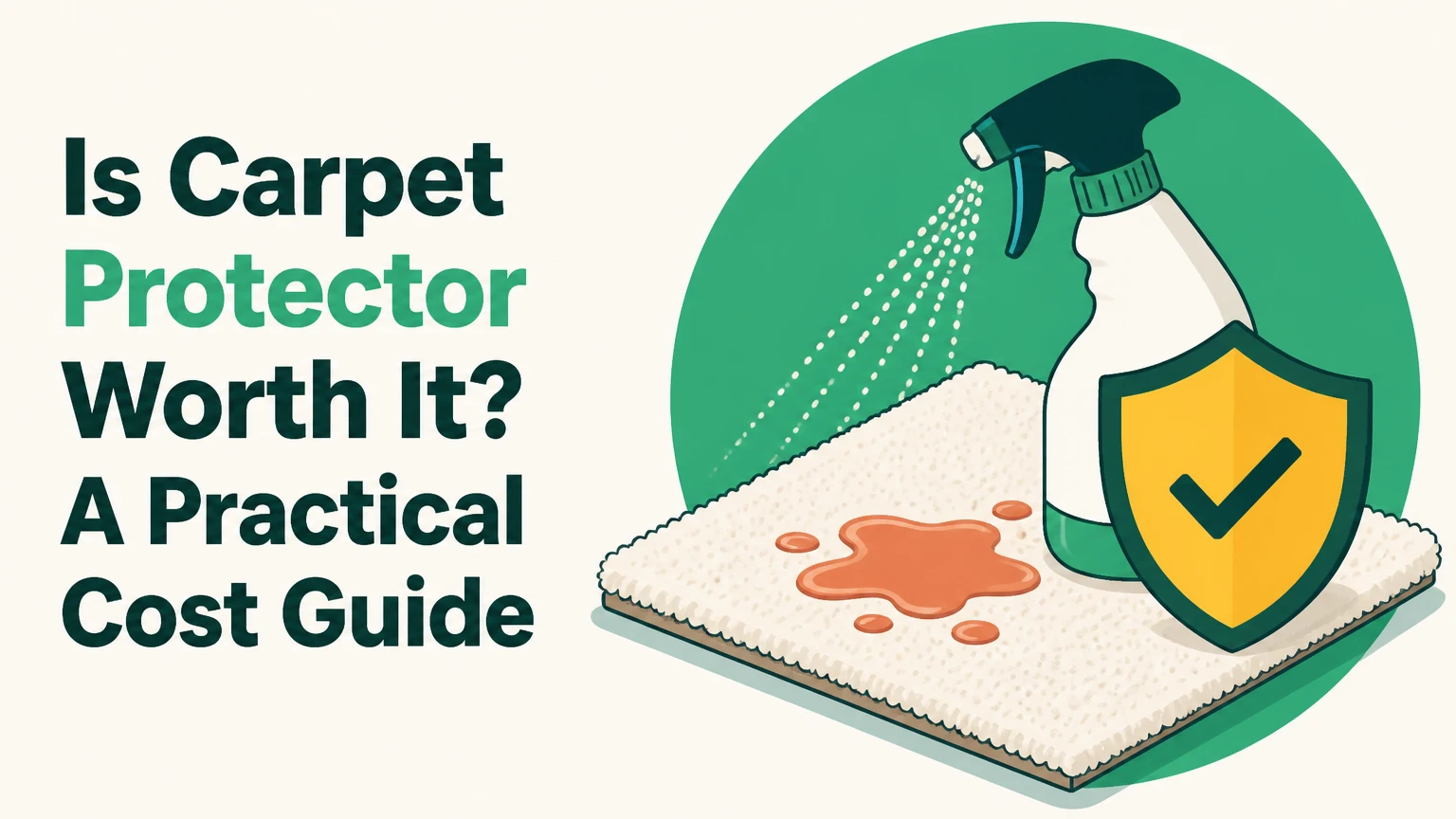
Carpet protector is worth it for many households, especially homes with children, pets, frequent guests, shoes indoors, or expensive carpet. The treatment delays liquid absorption and helps dry soil release from fibers, giving you more time to blot spills. It is less worthwhile for low-traffic rooms, heavily worn carpet, or owners who will not respond quickly to spills.
Key Facts at a Glance
- Carpet protector repels many water-based spills; it does not make carpet stain-proof.
- Typical professional application costs about $0.15-$0.35 per square foot, or $20-$45 for an average room when added to cleaning.
- Protection commonly lasts 12-24 months, but hallways and stairs may wear faster than bedrooms.
- The best application follows thorough hot-water extraction after detergent and soil residues have been removed.
- Nylon, polyester, wool, and plant fibers require different product choices and testing procedures.
- Fast blotting, entrance mats, and regular vacuuming remain necessary after treatment.
Is Carpet Protector Worth It for Your Home?
Carpet protector usually earns its cost when the carpet has meaningful replacement value and the household creates frequent spill or soil risk. A family room with nylon carpet, two children, and a dog receives more practical value than a rarely used guest bedroom with no shoes, pets, or food.
The treatment buys response time rather than permanent immunity. A drink that beads for several minutes can often be blotted before the dye reaches the backing, while an untreated spill may spread through the pile immediately. The result depends on the liquid, temperature, carpet fiber, dye system, application quality, and age of the treatment.
Carpet and Rug Institute guidance uses the phrase “resistance to staining,” rather than stain-proof performance. That distinction matters because staining occurs when a substance chemically bonds to or colors the fiber; repellency mainly slows penetration and improves removal conditions.
A practical return-on-cost test
Use the following test before approving an upsell:
- Estimate the protected area in square feet.
- Multiply the quoted price by the number of applications expected during the carpet’s remaining life.
- Compare that amount with the cost of professional stain removal, partial replacement, or earlier carpet replacement.
- Add the value of convenience if household members regularly spill drinks or track soil indoors.
For example, 600 square feet at $0.25 per square foot costs about $150. Reapplying every 18 months for six years would cost approximately $600 before price changes. That can be reasonable for premium carpet, but poor value for carpet already flattened, permanently discolored, or due for replacement.
How Does Carpet Protector Work?
Carpet protector changes the fiber surface so some liquids spread less readily and some dry soil releases more easily during vacuuming. The treatment forms a thin coating around exposed fiber surfaces; it does not create a sealed plastic film over the entire carpet.
Liquid repellency
A repellent treatment lowers the tendency of water-based liquids to wet the fiber surface. The liquid may form a bead or remain near the top of the pile, allowing blotting before capillary action carries it downward.
Performance is not universal. Hot coffee, colored sports drinks, oily gravy, urine, bleach, and acidic cleaners behave differently. Heat can accelerate penetration, while oil-based materials may defeat a product designed primarily for water repellency.
Dry-soil resistance
Dry soil contains abrasive mineral particles that can work into microscopic irregularities on synthetic fibers. Repeated foot traffic then bends and scratches the fiber surface, producing gray traffic lanes even when the carpet is not deeply stained.
A suitable protector reduces soil adhesion and can improve vacuum removal. It does not remove grit already embedded in the carpet, and it cannot prevent wear caused by insufficient vacuuming, poor entry mats, or heavily concentrated foot traffic.
What chemistry is involved?
Many professional products use fluorinated chemistry, polymer technology, or combinations of repellency and dye-resistance additives. Product chemistry has changed over time because some older long-chain perfluoroalkyl substances were associated with environmental persistence and have been restricted or phased out in many markets.
“Fluorochemical” does not identify one single substance or automatically answer a product-safety question. Ask the cleaner for the product name, safety data sheet, intended fiber types, fluorine or PFAS disclosure, ventilation instructions, and manufacturer application label.
Silicone products can provide strong water repellency, but poorly selected formulations may increase oily soil attraction or leave a residue. Plant-based and fluorine-free products may suit some households, although their oil resistance and durability vary by formulation rather than by the word “natural.”
Which Carpet Protector Type Fits Each Fiber?
The correct protector depends first on fiber and dye system, then on the household’s spill pattern. A product made for synthetic wall-to-wall carpet should not be assumed safe for wool, silk, sisal, jute, or viscose.
| Protector type | Typical strength | Best application | Main limitation |
|---|---|---|---|
| Fluorochemical or polymer repellent | Water and dry-soil resistance | Nylon and polyester in active homes | Product chemistry and PFAS disclosure vary |
| Acid dye blocker | Red-dye and artificial-color resistance | Nylon exposed to drinks and food dyes | It is not a complete soil or oil repellent |
| Silicone-based repellent | Strong water beading | Selected outdoor or specialty materials | Poor formulas can attract oily soil |
| Fluorine-free or plant-based treatment | Lower chemical concern for some users | Chemically sensitive or eco-conscious households | Oil resistance and durability may be lower |
| Wool-rated protector | Fiber-compatible liquid and soil resistance | Wool rugs and wool carpet | Requires label compliance and careful testing |
| No added treatment | No application residue or chemistry | Low-risk, low-traffic rooms | No additional spill-response time |
Nylon and polyester
Nylon often benefits from a protector because its exposed dye sites and surface characteristics can make certain colored spills difficult to remove. Polyester naturally resists many water-based stains, but oily soil can remain a problem, so a protector should be evaluated for oil and residue behavior rather than sold as a universal requirement.
Solution-dyed fibers already have strong colorfastness because pigment is incorporated through the fiber rather than applied only at the surface. Protection can still assist with soil release, but the incremental benefit may be smaller than it is on a more absorbent or dye-sensitive carpet.
Wool, sisal, silk, and viscose
Natural and regenerated fibers need specialist treatment. Wool can tolerate appropriate wool-rated products, while sisal and jute may react badly to excess moisture, uneven application, or unsuitable chemistry. Silk and viscose can change texture, swell, distort, or develop permanent water marks.
A WoolSafe-approved or explicitly fiber-rated product is the safer starting point for wool. A professional should test an inconspicuous area, confirm dye stability, control moisture, and document the product used.
How Much Does Carpet Protector Cost?
Typical professional carpet protection costs $0.15-$0.35 per square foot, or roughly $20-$45 for an average room when added to a cleaning service. Local labor, product grade, furniture moving, minimum charges, carpet condition, and whether the cleaner treats edges or stairs can move the quote substantially.
| Area or service | Typical quantity | Typical price | Typical decision context |
|---|---|---|---|
| Small bedroom add-on | 100-150 sq. ft. | $20-$45 minimum | Often worthwhile only with pets or children |
| Average room add-on | 150-250 sq. ft. | $30-$90 | Common post-cleaning treatment |
| Open living area | 300-600 sq. ft. | $75-$210 | Better value when traffic and spills are high |
| Stairs and hallway | 100-250 sq. ft. | $30-$90 | Wear may shorten service life |
| Whole-home treatment | 800-1,500 sq. ft. | $120-$525 | Compare with carpet age and replacement cost |
| DIY consumer spray | Product-specific | $15-$60 per container | Coverage and uniformity vary |
A quote should specify whether the price includes cleaning, protector dilution, furniture movement, drying instructions, and a written product name. A very low price may indicate inadequate coverage, excessive dilution, or a product intended for upholstery rather than carpet.
What determines the final price?
Carpet area is only one variable. Stairs require more labor per square foot, furniture can restrict access, and heavily soiled carpet may need extra extraction before protection can bond evenly. Some companies also charge separately for deodorizer, pet treatment, stain removal, or accelerated drying.
Do not compare a protector-only price with a cleaning-plus-protection package without separating the services. The treatment has little value if sticky detergent, oily soil, or pet contamination remains in the pile.
When Should Carpet Protector Be Applied?
Carpet protector should normally be applied after a thorough professional cleaning and rinse, once visible soil and detergent residue have been removed. A clean, residue-free surface gives the treatment a more consistent chance to contact the fiber rather than coating old soil.
A typical professional sequence takes about 30-90 minutes beyond cleaning for preparation and application, followed by 2-6 hours of drying under ordinary ventilation. Full performance may require longer according to the product label, humidity, airflow, and carpet density.
The professional application sequence
- Inspect the carpet. Identify fiber, construction, dye behavior, previous treatments, stains, wear, and manufacturer restrictions.
- Clean and rinse thoroughly. Remove dry soil, detergent residue, oils, and pet contamination before applying any repellent.
- Confirm dilution. Mix the concentrate according to the manufacturer’s label rather than using a generic ratio.
- Apply evenly. Use calibrated spray equipment and overlap passes so exposed fibers receive consistent coverage.
- Groom the pile. Distribute the treatment through the pile without flooding the backing.
- Dry with airflow. Keep people and pets off the carpet until it is fully dry.
- Test the result. A small water-drop test can indicate surface repellency, but it does not prove resistance to every stain type.
The exact spray pressure, tip, application rate, and grooming method are product-specific. A 6501 fan tip or a 40-60 PSI setting may be suitable for some professional systems, but copying those numbers onto a different product can cause overapplication.
How should a homeowner apply DIY protector?
DIY application is reasonable for a small, clean, synthetic rug when the label clearly identifies the fiber, coverage rate, ventilation requirements, and drying time. Vacuum first, patch-test, protect nearby surfaces, apply light overlapping passes, and never saturate the backing.
Professional application is preferable for wall-to-wall carpet, wool, stairs, expensive rugs, or homes with prior residue problems. Uniform coverage is difficult to judge from an aerosol can, and excess product can leave a stiff hand or increase resoiling.
What Are the Benefits and Limitations?
Carpet protector improves spill response and soil release, but the benefit is conditional rather than absolute. The strongest value appears when people notice spills quickly and maintain the carpet with frequent vacuuming and sensible entry control.
| Benefit | Practical effect | Evidence level | Important condition |
|---|---|---|---|
| Slower liquid wetting | More time to blot the spill | Product-dependent | Works less reliably with heat and oils |
| Easier dry-soil removal | Less grit remains attached | Mechanism-based | Requires regular vacuuming |
| Reduced immediate dye penetration | Lower chance of a rapid setting stain | Fiber and dye dependent | Red dyes can still stain |
| Cleaner appearance between services | Traffic lanes may develop more slowly | Practitioner observation | Mats and vacuuming remain decisive |
| Potentially longer usable life | Less abrasive soil contact | Situation-dependent | Cannot reverse fiber wear |
| Easier spot cleaning | Blotting can remove more material | Product and spill dependent | Never scrub aggressively |
The “10-15 minute window” sometimes advertised is not a guaranteed performance period. A cold water spill on a treated synthetic carpet may remain near the surface for that long, while hot coffee, oily sauce, urine, or a concentrated dye can penetrate much sooner.
Protector also cannot correct a structural problem. Matted pile, delamination, fading, bleach damage, pet urine contamination in the cushion, and permanent traffic wear require different remedies.
Carpet Protector Versus Other Protection Methods
Carpet protector is one layer in a maintenance system, not the only way to reduce carpet damage. In high-risk entry areas, a good mat often prevents more soil than a chemical treatment because it stops grit before grit reaches the carpet.
| Protection method | Typical cost | Useful life or frequency | Best risk addressed |
|---|---|---|---|
| Professional carpet protector | $0.15-$0.35/sq. ft. | 12-24 months typical | Spills and soil adhesion |
| Machine-washable entry mat | $20-$150 each | 1-5 years | Outdoor grit and moisture |
| Professional cleaning | $0.20-$0.60/sq. ft. typical | Every 6-18 months | Embedded soil and residues |
| Carpet runner | $50-$300 | 2-7 years | Repeated hallway abrasion |
| Area rug over carpet | $50-$500+ | 2-10 years | Furniture and spill zones |
| No-shoes household rule | $0 | Continuous | Dry soil and outdoor contamination |
When are mats better?
Mats are usually the higher-value first purchase at entrances, especially during wet or muddy seasons. A mat captures particles before they become abrasive soil, while protector only changes how strongly particles attach after they reach the carpet.
Mats do not solve spills in a dining room or pet accidents beside a sofa. The best combination for an active household is a correctly sized, cleanable entry mat plus protection in the areas where liquid spills are likely.
When is stain-resistant carpet a better choice?
If carpet replacement is imminent, choosing solution-dyed polyester or a manufacturer-rated stain-resistant construction may provide more durable protection than repeatedly treating old carpet. Fiber type, pile density, backing, warranty terms, and color still matter.
Added protector does not automatically preserve a carpet warranty. Check the carpet manufacturer’s care requirements before applying a third-party product, particularly on new carpet or specialty fibers.
Who Should Buy Carpet Protection?
The best candidates are households with expensive or relatively new carpet and a predictable source of liquid spills or tracked soil. The weakest candidates are owners of worn carpet, unused rooms, or carpets that already require replacement.
| Household situation | Recommendation | Priority area | Reason |
|---|---|---|---|
| Two children and frequent snacks | Usually worthwhile | Living and dining areas | Colored drinks and food reach carpet often |
| Dog or cat with occasional accidents | Selective application | Pet routes and sofa zones | Repellency buys response time, but does not neutralize urine |
| Shoes worn indoors | Worth considering | Entry, stairs, hallway | Dry-soil resistance supports frequent vacuuming |
| Low-traffic guest room | Usually skip | None or doorway | Few spill events reduce return |
| Rental property turnover | Often worthwhile | Main tenant-use areas | Cleaner turnover can reduce restoration costs |
| Wool rug owner | Specialist-only | Professionally assessed zones | Wrong chemistry can damage fiber or dyes |
| Carpet older than 10 years | Usually skip | Replace or clean first | Treatment cannot restore worn pile |
Pet owners should not treat protector as an odor solution. Urine can travel into backing and cushion, where surface repellency has little effect; enzyme-compatible remediation and moisture inspection are more important when contamination is established.
Landlords should review lease terms and local housing rules before charging tenants for treatment. Protection may reduce cleaning risk, but it cannot justify retaining a deposit for ordinary wear.
What Commonly Goes Wrong?
Most protector failures result from unsuitable chemistry, dirty carpet, uneven coverage, excessive product, or unrealistic expectations. Diagnosing the failure correctly matters because repeated spraying can worsen residue and resoiling.
Carpet becomes crunchy
A stiff or crunchy feel usually indicates overapplication, incomplete grooming, dried residue, or product incompatibility. Vacuum slowly in multiple directions after the carpet is completely dry; persistent residue may require controlled rinsing by a professional.
Carpet resoils within weeks
Rapid resoiling often points to sticky detergent, oily prespray residue, or a low-quality product rather than a lack of protector. The remedy is extraction with appropriate rinse chemistry and improved vacuuming, not another layer of repellent.
Spills absorb immediately
Immediate absorption can mean the treatment has worn away, the product was diluted incorrectly, the carpet was never covered evenly, or the spill is hot, oily, or highly concentrated. Test several locations, because one worn walkway does not represent the whole room.
Stains remain after treatment
Protector does not remove existing stains and cannot guarantee removal of acid dyes, rust, bleach, permanent marker, or pet urine. Treat the spill according to its chemistry, blot rather than scrub, and identify the fiber before selecting a spotter.
The carpet looks patchy
Uneven appearance can follow inconsistent spray overlap, pile distortion, furniture shadows, or different wear rates. A professional should inspect the pattern before reapplying, because additional chemical may conceal rather than correct the cause.
How Long Does Carpet Protector Last?
Carpet protector typically lasts 12-24 months in residential carpet, but high-use stairs, hallways, and doorways may lose effective repellency sooner. Heavy traffic, abrasive soil, frequent wet cleaning, aggressive brushing, and strong spot-cleaning chemicals shorten the interval.
| Location | Typical service life | Main wear factor | Sensible review point |
|---|---|---|---|
| Guest bedroom | 18-36 months | Occasional vacuuming | Test before annual cleaning |
| Family room | 12-24 months | Foot traffic and food spills | Review every 12-18 months |
| Hallway | 6-18 months | Concentrated abrasion | Inspect at 6-12 months |
| Stairs | 6-18 months | Repeated edge contact | Inspect during each cleaning |
| Dining area | 9-18 months | Food, oil, chair movement | Review after major spills |
| Wool area rug | Product-specific | Fiber sensitivity and cleaning | Follow specialist schedule |
Professional cleaning does not always strip every remaining molecule of protector, so automatic reapplication after every cleaning is not universally necessary. Test the product’s current performance, follow the label, and avoid paying for unnecessary treatment.
A water-drop test is only a rough field indicator. A protected surface may repel water while still absorbing oil or colored liquid, and a single test spot cannot establish uniform coverage across a room.
How Can You Make Protection Last Longer?
Vacuuming, entry control, spill response, and correct cleaning preserve the practical value of carpet protection longer than repeated chemical application. Remove dry grit before traffic grinds it into the fiber, then address liquid contamination before it migrates into the backing.
Use a high-quality mat outside and inside each primary entrance, vacuum high-traffic lanes at least twice weekly in active homes, and blot fresh spills with white absorbent towels. Do not scrub, use a household carpet powder, or apply an untested solvent.
Keep pets away until treated carpet is fully dry. Follow the product label for ventilation and re-entry, because drying time varies with humidity, airflow, pile density, and application volume.
A Better Buying Checklist
Before approving carpet protection, ask the cleaner these specific questions:
- What is the exact product name and manufacturer?
- Is the product rated for my fiber, dye system, and carpet backing?
- Does the formulation contain fluorinated chemistry or disclose PFAS information?
- What application rate and coverage area does the label specify?
- Is cleaning and residue removal included before application?
- How many square feet will be treated?
- What drying and re-entry time should I expect?
- Is the quoted price for one treatment or a maintenance plan?
- Does the carpet manufacturer’s warranty restrict third-party treatments?
- What happens if the carpet feels stiff or resoils rapidly?
A responsible provider should answer without promising stain-proof performance. The provider should also document pre-existing stains and explain which spills the product is designed to resist.
Frequently Asked Questions
Does carpet protector stop pet urine?
Carpet protector can slow surface wetting from a small fresh accident, but it cannot stop urine from reaching backing, cushion, or subfloor once enough liquid is present. Pet urine requires immediate blotting and, when contamination penetrates below the pile, enzyme-compatible treatment or professional inspection.
Can I vacuum carpet after applying protector?
You can vacuum after the carpet has dried completely and the product label permits re-entry. Waiting commonly takes 2-6 hours under normal conditions. Vacuuming wet treatment can disturb coverage, transfer product to equipment, and increase the risk of uneven appearance.
Does carpet protector change carpet color?
Correctly selected and applied protector should not materially change carpet color, but unsuitable chemistry, overapplication, dye instability, or residue can create darkening, stiffness, or patchiness. Test an inconspicuous area first, especially on wool, viscose, sisal, jute, and hand-dyed rugs.
Is carpet protector safe for babies and pets?
Safety depends on the specific formulation, label directions, ventilation, and complete drying rather than the generic term “carpet protector.” Keep babies and pets off the carpet during application and drying, request the safety data sheet, and follow the manufacturer’s re-entry instructions.
Can carpet protector be applied over an old stain?
Carpet protector can be applied after an old stain has been properly treated, but it will not hide or remove the discoloration. Cleaning first is essential because applying protector over soil or sticky residue can trap contaminants and contribute to rapid resoiling.
Should carpet protector be reapplied after every cleaning?
Carpet protector does not automatically require reapplication after every cleaning. Check repellency, traffic wear, the cleaning method, and the product label first. Reapply when protection has materially declined, particularly in high-use zones, rather than following an automatic annual upsell.
The Bottom Line
Carpet protector is worth it when a household has frequent spills, pets, children, indoor shoes, or high-value carpet and can respond quickly to accidents. The treatment is usually a poor investment for unused rooms, badly worn carpet, or owners expecting permanent stain resistance.
For the strongest result, clean and rinse the carpet first, select chemistry for the fiber, apply the product at its labeled rate, and maintain entrance mats and vacuuming. The answer to “is carpet protector worth it” is therefore conditional, but the decision is straightforward: protect clean, valuable, high-risk carpet, and skip treatment where traffic and spill exposure are minimal.