
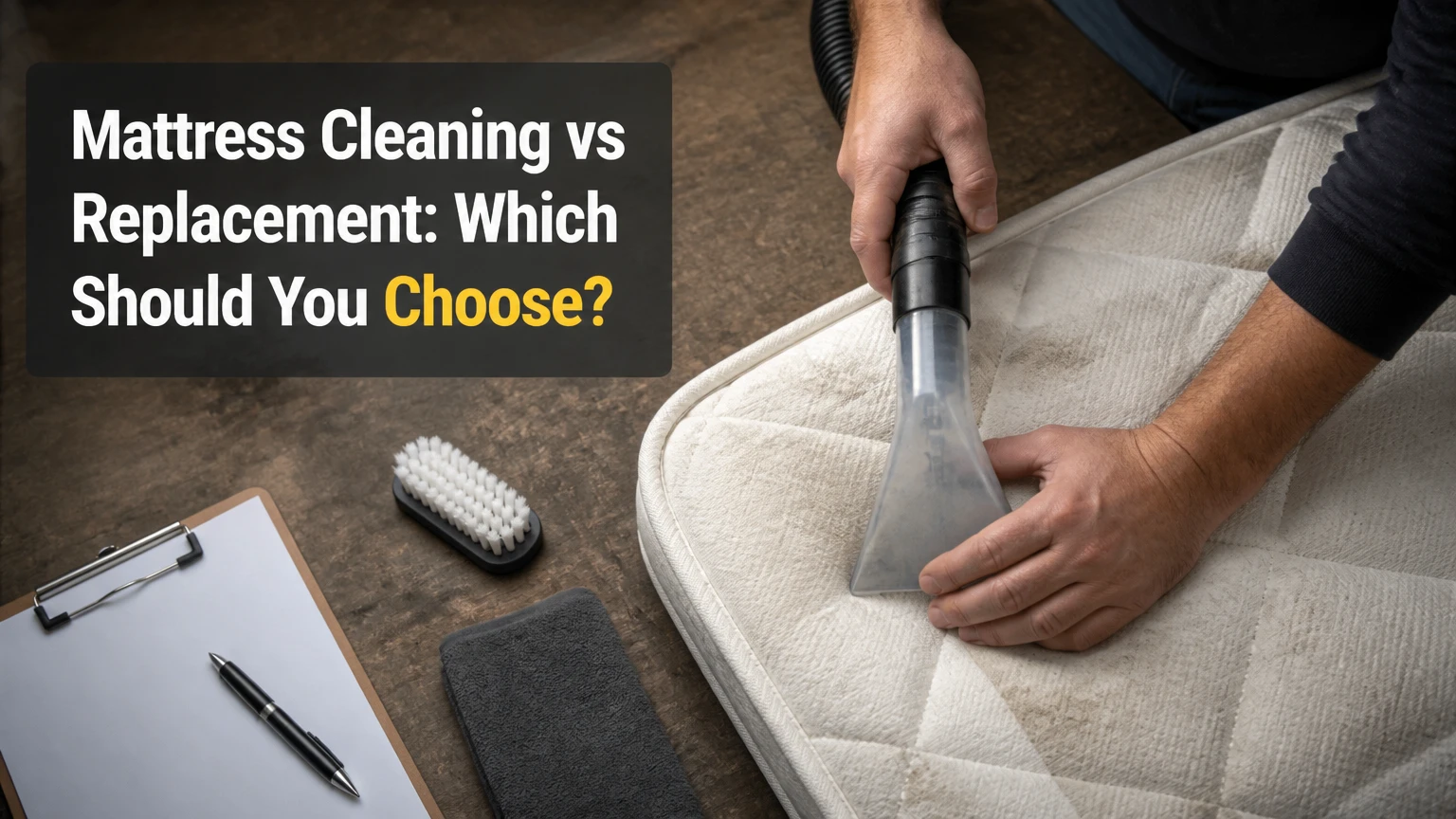
Mattress cleaning is the better choice when the mattress remains flat, supportive, dry, and free from deep contamination. Mattress replacement is the better choice when the bed sags, causes new pain, contains internal mold, has severe pest contamination, or has exceeded its useful service life. Age alone does not decide the outcome.
Key Facts at a Glance
- Cleaning removes surface soil, body oils, odors, and some allergens, but it cannot restore collapsed foam or broken coils.
- A mattress with visible mold inside, floodwater exposure, or extensive bed-bug infestation usually requires replacement rather than household cleaning.
- Typical mattress life ranges from 5-8 years for budget innerspring models to 10-15 years for well-made latex models.
- A DIY refresh typically costs $10-$35 and requires 8-24 hours of drying; professional cleaning commonly costs $80-$250.
- A sagging mattress can remain hygienic after cleaning while still providing poor spinal support.
- A waterproof, breathable protector prevents more contamination than repeated surface deodorizing.
Mattress Cleaning vs Replacement: The Decision Rules
Mattress cleaning is appropriate for removable surface contamination on a structurally sound bed. Replacement is appropriate when the mattress has lost support, retained moisture internally, or presents a contamination problem that cannot be reliably isolated.
The practical test has four parts: structure, moisture, contamination, and sleep performance. Inspect the mattress in daylight, measure any visible dip with a straightedge, check for musty odor after full airing, and note whether pain or stiffness improves when sleeping elsewhere. A clean mattress that still produces pressure points has failed as a sleep surface.
Clean the mattress when
Choose cleaning when all of these conditions are true:
- The mattress is generally within its expected service life.
- Surface stains or odors are localized rather than pervasive.
- No internal mold, floodwater, or bed-bug evidence is present.
- The cover, seams, and foam remain intact.
- The mattress still feels supportive and comfortable.
Replace the mattress when
Replacement becomes the rational choice when one or more major failure signals appear:
- A permanent body impression affects sleep position or exceeds roughly 1.5 inches.
- Coils protrude, squeak persistently, or shift beneath the comfort layers.
- Foam crumbles, splits, remains compressed, or has developed a strong chemical or musty smell.
- Floodwater, sewage, or contaminated liquid reached the interior.
- Mold appears on multiple surfaces or returns after drying.
- Bed bugs, eggs, or fecal spotting persist after professional pest treatment.
- The mattress causes pain that is absent on another suitable bed.
- Cleaning and repair would cost more than about 25-40% of a comparable replacement.
The 25-40% rule is a budgeting heuristic, not a safety standard. A relatively new premium mattress may justify professional remediation, while a ten-year-old budget mattress may not.
What Can Cleaning Fix, and What Can It Not Fix?
Cleaning can improve hygiene and appearance, but cleaning cannot reverse mechanical deterioration. The distinction matters because stains are visible while loss of support often develops gradually inside foam or coil layers.
| Mattress problem | Cleaning effect | Replacement trigger | Best next action |
|---|---|---|---|
| Fresh sweat or drink stain | Usually improves surface discoloration | No trigger if fully dried | Blot and use a compatible spot cleaner |
| Light body odor | Often reduces odor | Odor returns from the core | Inspect moisture history and consider replacement |
| Dust and skin debris | Removes surface particles | Persistent symptoms after controls | HEPA vacuum, encasement, medical advice |
| Localized urine accident | May reduce odor if treated quickly | Liquid reached inner foam | Enzymatic blotting, then reassess |
| Permanent sagging | No structural improvement | Dip affects alignment or comfort | Replace mattress and inspect foundation |
| Broken coil or exposed wire | No improvement | Any protruding or unstable metal | Stop using and replace |
| Surface mildew | May remove visible growth temporarily | Musty odor or recurring growth | Isolate, assess moisture, usually replace |
| Bed bugs | Cleaning alone is insufficient | Live insects or eggs remain | Use licensed pest control and assess disposal |
A practitioner rule is simple: treat a stain as a cleaning problem only when the liquid stayed near the surface and the mattress dried completely. A repeated odor after two complete drying cycles suggests contamination below the cover, not merely poor deodorizing.
How Old Is Too Old for Cleaning?
A mattress is not automatically unsafe at a particular age, but older construction raises the probability of support loss, compressed comfort layers, and hidden moisture. Lifespan estimates should be adjusted for sleeper weight, nightly use, rotation, foundation quality, humidity, and material density.
| Mattress type | Typical useful life | Inspect more closely after | Main aging failure |
|---|---|---|---|
| Budget innerspring | 5-7 years | 4 years | Coil fatigue and edge collapse |
| Memory foam | 7-10 years | 6 years | Permanent impressions and softening |
| Hybrid | 7-10 years | 6 years | Foam compression over coil support |
| Polyfoam all-foam | 4-8 years | 4 years | Density loss and body impressions |
| Natural latex | 10-15 years | 8 years | Surface wear and comfort-layer fatigue |
The quoted ranges are typical, not guarantees. The Better Sleep Council commonly frames replacement around comfort and support rather than a fixed date, which is more useful than treating a manufacturer warranty as a lifespan promise. A ten-year warranty may cover a defect while excluding normal softening, stains, or comfort preference.
How should age change the decision?
For a mattress under five years old with a minor stain, cleaning is usually sensible. Between five and eight years, condition and sleep quality should carry more weight than age. Beyond eight years, professional cleaning is worthwhile only when the mattress remains structurally excellent and the contamination is clearly superficial.
How to Clean a Mattress Safely
A safe mattress-cleaning process uses minimal liquid, compatible products, and complete drying. Most household damage occurs when owners saturate foam, trap moisture under bedding, or apply a chemical that the care label prohibits.
Step 1: Read the law tag and remove bedding
Check the manufacturer’s care instructions before applying water, heat, peroxide, enzyme products, or upholstery machines. Remove sheets, blankets, pillows, and the protector; launder washable bedding according to its label, since a clean mattress can be recontaminated by dirty textiles.
Step 2: Vacuum the entire surface
Use a HEPA-filter vacuum with an upholstery attachment. Move slowly across the top, sides, seams, handles, and tufting, giving each 30-60 centimetre section two passes. Vacuuming removes dust, skin flakes, hair, and debris; it does not reliably eliminate deep dust mites or sanitize the mattress.
Step 3: Treat stains without soaking
Test the product on an inconspicuous area. Apply cleaner to a white cloth rather than flooding the mattress, then blot from the outside of the stain toward its center.
For fresh urine, use a compatible enzyme product and follow its contact time. For blood, use cold water first because heat can set protein stains. Hydrogen peroxide can bleach fabric and damage some dyes, so the frequently repeated peroxide, baking soda, and dish-soap mixture should be treated as a spot-test option, not a universal formula.
Step 4: Deodorize only after surface cleaning
A thin layer of baking soda can absorb some surface odor. Leave it for 4-12 hours, then vacuum thoroughly; a 24-hour application is reasonable only when the room is dry and the mattress is not exposed to added moisture. Essential oils are poor substitutes for cleaning and may irritate sleepers or pets.
Step 5: Dry the mattress completely
Position the mattress so air reaches both sides, use a fan, and keep humidity low. Do not remake the bed until the surface and seams feel fully dry and no cool, damp areas remain. Foam can retain moisture below a dry-feeling cover, so allow at least 8-24 hours for a damp spot and longer in humid weather.
The success checkpoint is absence of dampness, returning odor, and tacky residue. If any remains, stop adding product and increase airflow rather than applying another wet treatment.
Which Cleaning Method Fits Each Mattress?
The safest method depends on construction and contamination type. Professional hot-water extraction may work for some spring mattresses, but high moisture is risky for thick foam, and no cleaning method can guarantee removal of contamination from an absorbent core.
| Method | Typical cost | Drying or waiting time | Appropriate use | Important limitation |
|---|---|---|---|---|
| DIY HEPA vacuum and spot treatment | $10-$35 | 8-24 hours | Dust, fresh localized stains | Limited penetration |
| Low-moisture professional cleaning | $80-$180 | 2-8 hours | Odor and surface soil | Cannot repair structure |
| Hot-water extraction | $100-$250 | 12-48 hours | Compatible spring or fabric surfaces | Moisture can remain in foam |
| Steam treatment | $100-$250 | 8-24 hours | Selected surface fabrics | Heat and moisture may damage foam |
| UV-C service | $75-$200 | Minimal added drying | Surface microbial reduction claims | Shadowed and deep areas are untreated |
| Mattress replacement | $300-$2,000+ | 1-72 hours off-gassing | Structural failure or severe contamination | Disposal and selection cost |
UV-C should not be treated as a complete mattress sanitizer. Light cannot reach shaded seams or the interior, and consumer devices vary in irradiance, exposure time, and safety controls. Never expose skin or eyes to an open UV-C source.
How Much Do Cleaning and Replacement Cost?
Typical costs vary by country, size, access, contamination, and service method. DIY cleaning is inexpensive but carries the greatest risk of incomplete drying; replacement costs more immediately but may be cheaper than repeated services on a failing bed.
| Option | Typical price, USD | Labor or service time | Total disruption |
|---|---|---|---|
| DIY surface refresh | $10-$35 | 1-3 hours | 8-24 hours drying |
| Professional low-moisture clean | $80-$180 | 1-2 hours | Same day in many cases |
| Professional extraction | $100-$250 | 1-3 hours | 12-48 hours drying |
| Mid-range queen replacement | $600-$1,500 | 30-90 minutes selection | 1-7 days delivery |
| Premium latex or hybrid replacement | $1,200-$3,000+ | 1-2 hours selection | 1-14 days delivery |
| Removal and disposal | $30-$150 | 15-60 minutes | Same day or scheduled pickup |
A cleaning quote is poor value when it approaches the price of a replacement mattress with a return period. Conversely, replacing a structurally sound mattress after every minor spill creates unnecessary cost and bulky waste.
Which Mattress Materials Change the Answer?
Material affects both cleanability and replacement value. Innerspring models ventilate more readily, memory foam retains liquid in its cell structure, latex often resists indentation longer, and hybrids combine the failure patterns of foam comfort layers and coil support.
| Material | Cleaning tolerance | Common support life | Replacement consideration |
|---|---|---|---|
| Innerspring | Moderate, if quickly dried | 5-8 years | Check rust, coil noise, and edge collapse |
| Memory foam | Low to moderate moisture tolerance | 7-10 years | Replace after deep liquid penetration or crumbling |
| Latex | Moderate, label dependent | 10-15 years | Avoid harsh solvents and prolonged heat |
| Hybrid | Moderate on surface, variable in core | 7-10 years | Evaluate foam indentation and coil stability |
| Pillow-top | Low when heavily saturated | 4-8 years | Thick quilting can retain odor and moisture |
A latex mattress is not automatically mold-proof, and a memory-foam mattress is not automatically unhygienic. Construction density, cover design, room humidity, and liquid exposure determine practical performance.
What About Mold, Flooding, and Bed Bugs?
Mold, sewage, floodwater, and established bed bugs require a different risk assessment from ordinary dirt. Cleaning a contaminated mattress may remove visible marks while leaving spores, allergens, or insect eggs in inaccessible layers.
Replace a mattress after sewage exposure or prolonged floodwater contact because porous materials are difficult to decontaminate reliably. For small surface mildew, isolate the mattress, identify and correct the moisture source, and obtain professional advice; recurring odor or growth is a strong replacement signal.
Bed bugs are an exception to ordinary cleaning. Vacuuming and laundering can reduce insects, but they do not replace a coordinated pest-control treatment. Do not discard the mattress without wrapping and labeling it, because an uncovered mattress can spread insects through hallways, vehicles, and disposal areas.
Can a Topper Delay Replacement?
A topper can improve surface pressure relief for a short period, but it cannot correct a sagging support core. A 2-3 inch topper may mask mild comfort-layer wear for several months, while a deep dip will transfer through the topper and preserve poor alignment.
Use a topper only when the mattress is flat, stable, dry, and otherwise comfortable. Inspect the bed base first because missing center support, widely spaced slats, or a weak frame can mimic mattress sagging. Fixing the foundation may restore feel without buying a new mattress.
Do not use a topper to conceal broken coils, mold, persistent odor, or a body impression that causes pain. That approach adds material and cost while delaying the underlying decision.
What Should Allergy and Asthma Sufferers Do?
Allergy sufferers should reduce exposure rather than rely on mattress “sanitizing.” Use a fully enclosed allergen-resistant encasement, wash bedding according to its care label, control bedroom humidity, and vacuum surrounding floors; replace the mattress when symptoms persist alongside odor, moisture damage, or deep contamination.
The American Academy of Allergy, Asthma & Immunology recommends encasing mattresses and pillows for dust-mite control and washing bedding regularly in hot water where fabric-care instructions permit. A 60°C wash may reduce mites, but not every textile or machine supports that temperature, so the label takes priority.
A professional mattress cleaning may improve surface conditions, but it is not medical treatment. Persistent wheezing, congestion, rash, or nighttime coughing warrants evaluation by a qualified clinician rather than repeated chemical applications.
Common Mistakes and How to Recover
Saturating memory foam
Excess liquid can travel below the cover and dry slowly. Stop adding product, remove bedding, maximize airflow, and use a moisture meter if available; replace the mattress if odor or dampness persists.
Using bleach or mixed chemicals
Bleach can damage fabric, discolor foam, and create hazardous fumes when mixed with acids or ammonia. Rinse only according to the product instructions, ventilate the room, and consult the manufacturer before further treatment.
Scrubbing biological stains aggressively
Hard brushing spreads liquid and damages quilted covers. Blot with a clean cloth, change cloth sections frequently, and use a labeled enzyme product only when the material allows it.
Applying heat to a foam mattress
High heat can deform foam and accelerate material breakdown. Use room-temperature airflow unless the manufacturer specifically approves steam or heat.
Ignoring the foundation
A sagging base can produce the same uneven feel as a failed mattress. Check slat spacing, center rails, frame joints, and support legs before authorizing replacement.
Which Option Should You Choose?
Choose cleaning for a sound mattress with a small spill
A recently purchased mattress with one fresh stain usually needs prompt blotting, gentle spot treatment, and extended drying. A protector should be added after the mattress is fully dry.
Choose professional cleaning for valuable, lightly contaminated bedding
Professional low-moisture service makes sense for a premium mattress with surface odor, pet dander, or several localized stains when the structure remains excellent. Ask the provider about moisture volume, drying equipment, chemicals, and mattress-material compatibility.
Choose replacement for a painful, sagging, or contaminated mattress
Replacement is the strongest choice when the bed fails the support or contamination test. Do not spend on deodorizing when the body impression, broken coil, mold odor, or internal wetness remains.
Choose a topper only for mild comfort wear
A topper is a temporary comfort adjustment, not a structural repair. Use it when the mattress is flat and dry, and set a review date within six months.
How to Prevent the Next Replacement
Use a breathable waterproof protector from the first night, wash bedding at the hottest label-approved temperature, and vacuum the mattress surface every 3-6 months. Rotate the mattress 180 degrees only when the manufacturer permits it; many modern mattresses are one-sided and should not be flipped.
Keep bedroom humidity near 30-50% when practical, improve ventilation, and avoid eating or drinking over unprotected bedding. Address spills immediately because liquid exposure, not ordinary dust, is the contamination event most likely to turn a cleanable mattress into a replacement case.
Before buying a new bed, verify the trial period, return transport, warranty exclusions, foundation requirements, and disposal policy. A long warranty does not guarantee comfort or prevent normal softening.
FAQ
Does cleaning a mattress extend its life?
Cleaning can extend the useful life of a mattress by reducing surface soil, odors, and abrasive debris, especially when a protector prevents new contamination. Cleaning does not extend structural life after foam compression, coil failure, or foundation damage. Maintenance preserves condition; it does not restore worn support materials.
Can I clean a mattress after someone has vomited on it?
Clean a small, recent surface incident promptly with gloves, remove solids, blot moisture, and use a compatible enzyme cleaner. Replace the mattress when vomit penetrated deeply, the bed remained wet, contamination involved illness with unusual risk, or odor persists after complete drying and professional assessment.
Should I replace a mattress after a urine accident?
Replace the mattress when urine reached deep foam, created recurring odor, or caused persistent dampness. A fresh, localized accident on a protected mattress can often be treated with blotting and an appropriate enzyme product. Do not saturate the mattress while trying to remove the smell.
Is a ten-year-old mattress always unhygienic?
A ten-year-old mattress is not automatically unhygienic, but age increases the likelihood of support loss, accumulated allergens, and material fatigue. Evaluate sagging, odor, moisture history, surface damage, and sleep quality. A well-maintained latex mattress may remain usable longer than a heavily used low-density foam model.
Can professional cleaners remove dust mites completely?
Professional cleaning can reduce surface dust, debris, and allergen load, but complete removal of dust mites from a thick mattress cannot be guaranteed. Encasement, regular bedding care, humidity control, and floor cleaning provide ongoing exposure reduction. Persistent respiratory symptoms need medical assessment.
How do I dispose of an old mattress?
Wrap the mattress in plastic before moving it if local rules require containment, then use a municipal bulky-waste program, retailer take-back service, or licensed recycler. Never abandon a mattress beside a road or place it in an ordinary household bin. Check local regulations because disposal requirements vary.
The Bottom Line
The mattress cleaning vs replacement decision should follow condition, contamination, and sleep performance rather than age alone. Clean a dry, supportive mattress with manageable surface soil; replace one with sagging, broken components, recurring internal odor, mold, flood contamination, or persistent pest evidence. Spend on cleaning only when the mattress still succeeds at its primary job: supporting comfortable, restorative sleep.