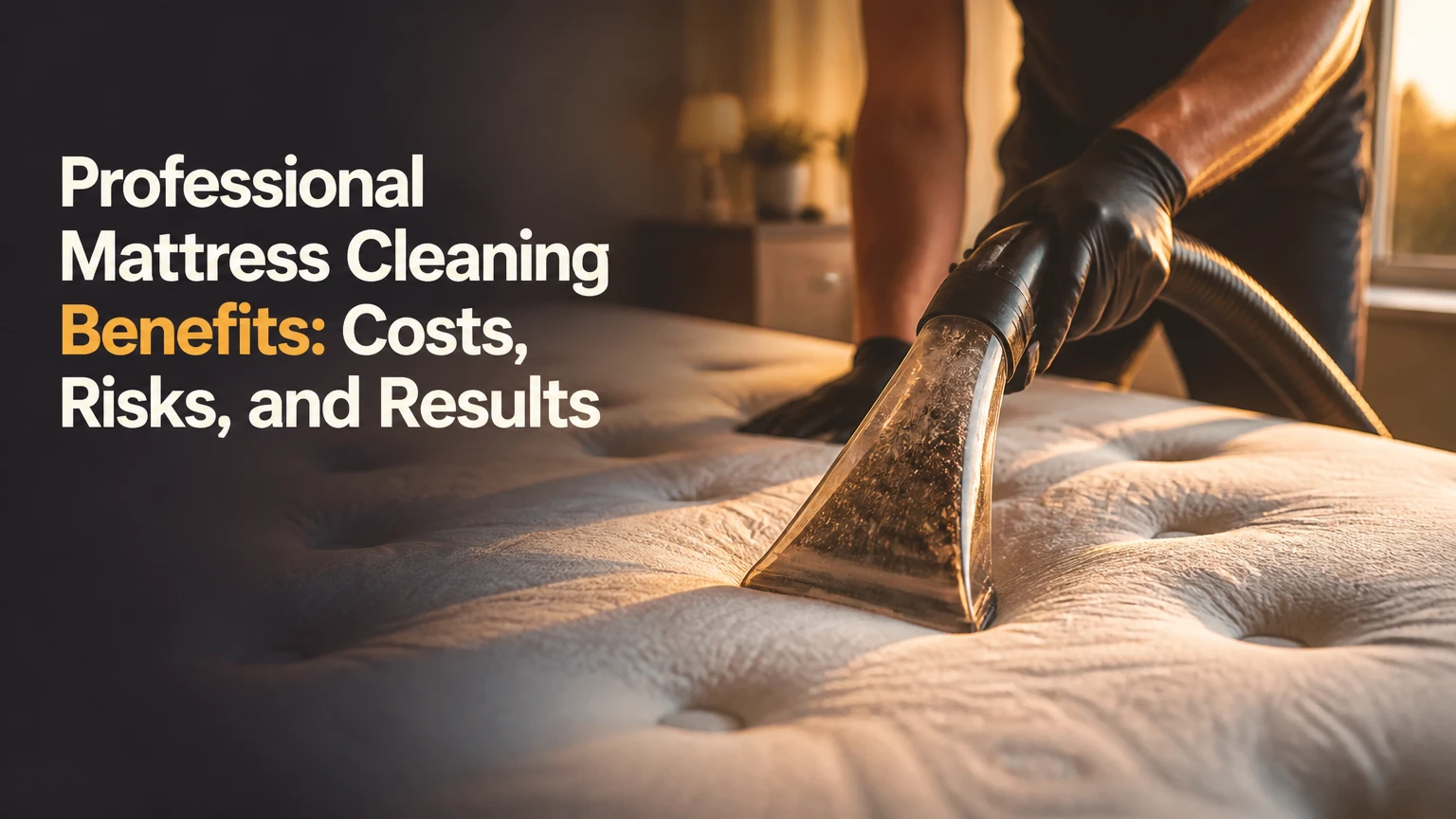
Professional mattress cleaning benefits include reduced surface and embedded soil, fresher odors, improved mattress hygiene, and safer stain treatment than improvised home methods. Professional mattress cleaning does not guarantee a sterile mattress, cure allergies, remove every stain, or repair mold and structural damage, so the method must match the mattress materials and care label.
Key facts at a glance
Professional mattress cleaning can remove sweat residue, skin flakes, body oils, dust, and some odor-causing deposits from mattress upholstery.
Hot-water extraction provides deeper soil removal but commonly requires 6-12 hours of drying in ordinary indoor conditions.
Low-moisture cleaning often reduces drying to approximately 2-4 hours, but it may remove less deeply dissolved contamination.
UV-C treatment is a surface treatment and cannot replace physical soil removal, stain treatment, or moisture-controlled extraction.
Typical residential service pricing ranges from approximately $45-$120 per mattress, with size, access, stains, location, and method affecting the quote.
A mattress protector, washable bedding, ventilation, and prompt spot treatment reduce the need for repeated deep cleaning.
Why Are Professional Mattress Cleaning Benefits Worthwhile?
Professional mattress cleaning is worthwhile when a mattress has accumulated visible stains, persistent odors, heavy body-oil residue, pet contamination, or dust that ordinary vacuuming cannot reach. The main value is controlled removal of soil from textile layers, followed by appropriate extraction and drying, rather than a promise of complete disinfection.
Mattresses collect shed skin, perspiration, skin oils, hair, household dust, and allergen-containing particles. Dust mites feed on skin flakes, while their feces and body fragments can contribute to allergy symptoms in sensitized people. The U.S. Environmental Protection Agency recommends moisture control, regular cleaning, and encasing bedding as part of dust-mite management, but cleaning alone does not eliminate an indoor mite population.
Professional service also reduces the risk of damaging foam or fabric with excessive water, unsuitable solvents, concentrated bleach, or aggressive scrubbing. A trained technician should inspect the construction, identify the stain chemistry, test a hidden area, and select a cleaning method that the manufacturer permits.
What Professional Cleaning Does Not Prove
A cleaned mattress is not automatically sterile, allergen-free, mold-free, or medically safer for every sleeper. “Sanitized” can describe a product or process claim, but the result depends on contact time, temperature, chemical concentration, mattress depth, and whether the treatment reaches the target organism.
A service cannot reliably remove mold growing inside a wet foam core, reverse yellowing caused by oxidation, restore broken springs, or erase urine that has penetrated deeply into cushioning. Those conditions may justify replacement or specialist remediation instead of repeated surface treatment.
How Does Professional Mattress Cleaning Work?
Professional mattress cleaning combines dry soil removal, controlled chemistry, mechanical agitation, targeted stain treatment, moisture management, and post-cleaning drying. The technician’s extraction performance and drying plan usually matter more than a single headline feature such as “steam” or “industrial power.”
The process normally follows this sequence:
- Inspect the mattress. The technician checks the care label, cover fabric, foam type, spring construction, stains, odor, seams, and evidence of mold or pest activity.
- Vacuum loose soil. A HEPA-filter vacuum removes hair, lint, dust, skin flakes, and surface particles before liquid is introduced.
- Apply a measured pre-spray. Detergent, enzyme chemistry, or a pH-adjusted solution loosens oils and protein-based deposits.
- Agitate gently. A soft brush or upholstery tool distributes the solution without tearing ticking or driving soil deeper.
- Treat spots separately. Blood, urine, coffee, oil, and vomit require different chemistry; one universal stain remover is unsafe.
- Rinse or extract. Hot-water extraction injects and recovers solution, while low-moisture systems use substantially less liquid.
- Control odor. Odor neutralization works best after the odor source has been removed, not when fragrance is sprayed over it.
- Accelerate drying. Air movers, ventilation, low indoor humidity, and time reduce the risk of musty odor and microbial growth.
Does Steam Cleaning Kill Dust Mites?
Heat can kill dust mites when the required temperature reaches the organism for sufficient contact time, but a brief pass over mattress fabric does not prove that every mite, egg, or allergen has been eliminated. Heat also does not remove allergen proteins unless the contaminated material is physically removed.
The American Academy of Allergy, Asthma & Immunology identifies bedding controls, hot washing where appropriate, mattress encasements, and humidity reduction as important dust-mite measures. A professional cleaner can reduce particulate and allergen load, but a dust-mite control plan must also address sheets, pillows, bedroom humidity, and floor dust.
Why Does Extraction Strength Matter?
Extraction performance determines how much dissolved soil and rinse water leave the mattress. Airflow, sealed contact, tool design, operator technique, and water lift all matter, so water-lift figures alone cannot guarantee a dry or clean result.
A dense memory-foam mattress can retain water below the surface even when its ticking feels dry. Professional equipment should recover liquid rather than saturate the core, and the provider should state the expected drying conditions before starting.
Which Cleaning Method Is Best for Each Mattress?
The best method depends on the mattress label, foam density, stain depth, fabric, odor source, and available drying conditions. Hot-water extraction generally provides the strongest soil removal, while low-moisture cleaning lowers moisture exposure; UV-C is supplementary rather than a complete cleaning method.
| Method | Typical liquid exposure | Typical drying time | Strongest use | Main limitation |
|---|---|---|---|---|
| Hot-water extraction | Approximately 0.5-2.0 L per mattress, equipment-dependent | 6-12 hours | Body oils, dissolved soil, moderate stains | Over-wetting can create odor, mildew, or foam damage |
| Low-moisture encapsulation | Approximately 0.1-0.5 L per mattress | 2-4 hours | Surface soil and foam-sensitive materials | Less effective on deeply penetrated urine or oil |
| Dry compound cleaning | Usually under 0.2 L of liquid, compound quantity varies | 1-3 hours | Light soil and short turnaround | Residual compound or limited deep-soil removal |
| UV-C treatment | 0 L added moisture | No drying period | Supplementary surface treatment | Does not remove dirt, stains, or deep contamination |
Hot-Water Extraction
Hot-water extraction loosens and rinses soils with a controlled solution, then removes much of that liquid through a vacuum tool. It is often appropriate for washable textile covers, heavy body oils, and contamination that has not reached an inaccessible foam core.
The phrase “steam cleaning” can mislead consumers. Many upholstery cleaners use heated water extraction rather than true steam, and a high temperature at the machine does not mean the same temperature reaches the mattress interior. Ask whether the service injects water, applies vapor, or uses both.
Low-Moisture and Dry Cleaning
Low-moisture systems apply a smaller volume of liquid or a cleaning compound that captures soil for later vacuuming. These methods reduce the chance of a saturated foam core and can suit mattresses with strict moisture limitations, provided the manufacturer allows the chemistry.
Low moisture does not mean risk-free. Some solvents, fragrances, polymers, or alkaline products can discolor fabric or leave residues. The provider should disclose the product category, ventilation requirements, and expected post-service residue.
UV-C and Vibration Treatment
UV-C uses short-wavelength ultraviolet radiation on exposed surfaces, sometimes with vibration and vacuuming. UV-C cannot treat shaded seams, deep foam, covered areas, or soil hidden beneath fabric, and its germicidal effectiveness requires a documented dose and adequate exposure.
Use UV-C as an adjunct when the service also removes soil. A zero-drying claim describes moisture, not complete cleaning.
What Are the Main Benefits and Trade-Offs?
Professional mattress cleaning can improve cleanliness and odor control while extending useful appearance, but the result depends on contamination depth and mattress condition. The strongest benefits occur when technicians remove the source of the problem instead of masking symptoms with fragrance or surface heat.
| Benefit | Mechanism | Likely outcome | Important boundary |
|---|---|---|---|
| Soil reduction | HEPA vacuuming, detergent, agitation, extraction | Less dust, oil, and skin residue | Deep foam may remain contaminated |
| Odor improvement | Source removal and neutralization | Fresher smell after full drying | Fragrance does not remove urine or mold |
| Stain improvement | Enzymes, oxidizers, reducers, controlled rinsing | Lighter or removed fresh stains | Set-in yellowing may remain |
| Allergen-load reduction | Physical removal of particles and residues | Lower mattress dust burden | Does not cure asthma or eliminate all mites |
| Material preservation | Correct pH, tools, and moisture control | Less avoidable fabric or foam damage | Cleaning cannot repair failed components |
| Mattress-life support | Removal of abrasive soil and oils | Cleaner upholstery over time | Replacement is necessary for severe deterioration |
Can Cleaning Improve Sleep or Allergies?
Cleaning may improve perceived freshness and reduce irritant exposure, but professional mattress cleaning is not a treatment for asthma, eczema, rhinitis, or insomnia. People with diagnosed allergies should follow a clinician’s plan and combine mattress cleaning with washable bedding, encasements, and bedroom humidity control.
The strongest household benefit is often odor and comfort. A sleeper may notice less mustiness, fewer irritating particles, and cleaner bedding even when clinical symptoms do not change.
What Happens During a Professional Service?
A single mattress commonly takes 30-60 minutes to clean, excluding setup and drying, although heavily stained, thick, king-size, or difficult-to-access mattresses take longer. Drying usually takes 2-4 hours after low-moisture work and 6-12 hours after substantial extraction.
| Service stage | Typical duration | Customer requirement | Completion check |
|---|---|---|---|
| Inspection and testing | 5-10 minutes | Provide care label and stain history | Method and risks explained |
| Dry vacuuming | 5-15 minutes | Remove bedding and loose objects | Surface debris visibly reduced |
| Pre-treatment and agitation | 10-20 minutes | Identify urine, blood, oil, or pet marks | Soil begins releasing without dye bleed |
| Extraction or low-moisture cleaning | 10-25 minutes | Provide electrical access and ventilation | No pooling or excessive saturation |
| Drying setup | 5-10 minutes | Keep mattress uncovered | Air movement reaches both exposed sides |
| Reuse | 2-12 hours | Confirm dryness before covering | Fabric and seams feel dry, no cool dampness |
Before the appointment, strip all bedding, wash sheets and protectors, clear access around the bed, and tell the technician about pregnancy, children, pets, fragrance sensitivity, allergies, and previous chemicals. Do not apply additional stain remover immediately before service.
A mattress should remain uncovered until its surface and seams are completely dry. Sheets placed over a damp mattress slow evaporation and can trap odor inside the cover.
How Much Does Professional Mattress Cleaning Cost?
Typical residential mattress cleaning costs approximately $45-$120 per mattress, with larger sizes, severe stains, travel distance, access, and specialized odor treatment increasing the quote. Prices vary widely by country and city, so a local written estimate is more useful than a universal average.
| Cost factor | Typical range or effect | Why it changes price |
|---|---|---|
| Twin or single mattress | $45-$70 | Smaller surface and lower solution use |
| Queen mattress | $60-$95 | Common residential baseline |
| King mattress | $80-$120 | Larger surface and longer extraction |
| Severe urine or pet treatment | Add $20-$60 | Enzyme treatment and repeat passes |
| Same-day or difficult access | Add $15-$50 | Travel, stairs, setup, or scheduling |
| Low-moisture premium service | Add $10-$40 | Specialized equipment and chemistry |
Ask whether the quote includes inspection, stain treatment, deodorization, drying equipment, tax, travel, and a return visit. A very low advertised price may cover only vacuuming or surface deodorizing.
Is DIY Cleaning Good Enough?
DIY vacuuming and spot cleaning are appropriate for routine maintenance, fresh spills, and light surface soil. Professional cleaning becomes more useful when contamination is widespread, the mattress is valuable, stains are old, or a homeowner cannot control moisture and extraction safely.
| Approach | Equipment | Typical time | Best result | Main risk |
|---|---|---|---|---|
| Home vacuuming | HEPA vacuum, upholstery tool | 10-20 minutes monthly | Loose surface particles | Cannot rinse dissolved soil |
| Home spot treatment | White cloth, cool water, mild detergent | 5-20 minutes per spot | Fresh small spills | Over-wetting and dye migration |
| Rental extractor | Portable spray-extraction machine | 1-3 hours | Moderate removable soil | Excess water remains in foam |
| Professional service | Commercial vacuum, tools, air movers | 30-60 minutes plus drying | Controlled whole-mattress cleaning | Poor provider can still over-wet |
Homeowners should never pour water onto a mattress, saturate memory foam, use undiluted bleach, or mix oxidizers with acids or ammonia. Blot fresh liquid, ventilate the room, and consult the care label before using any chemistry.
Which Users Need a Different Approach?
Allergy sufferers, pet owners, parents, and memory-foam owners should not automatically choose the same service. The correct decision depends on the contaminant and the mattress’s moisture tolerance.
Allergy and Asthma Households
Choose physical soil removal, HEPA vacuuming, washable encasements, and humidity control rather than a fragrance-heavy “sanitizing” package. A six-month cleaning interval may be reasonable for severe exposure, while many households can schedule professional service every 12 months and maintain bedding weekly.
Pet Owners and Parents
Fresh urine, vomit, and milk should receive prompt blotting and a properly formulated enzyme treatment. Enzymes need suitable dwell time and should not be combined with disinfectants that deactivate them; deeply penetrated urine may require several treatments or mattress replacement.
Memory-Foam Mattress Owners
Memory foam requires particular caution because its open or closed cell structure can retain liquid. Request low-moisture cleaning unless the manufacturer explicitly permits extraction, and ask how the provider will dry the mattress core rather than relying on surface touch.
Latex, Hybrid, and Spring Mattresses
Latex can be damaged by prolonged moisture, while hybrid mattresses combine foam, fabric, and metal components with different tolerances. Spring units may dry more readily than thick foam, but rust and trapped moisture remain possible if liquid reaches the border or coil pocket.
When Should You Replace Rather Than Clean?
Replace a mattress when it has internal mold, persistent urine saturation, bedbug activity, broken support, exposed foam, severe sagging, or an odor that remains after complete drying and source removal. Cleaning is a hygiene intervention, not a repair for structural failure or advanced biological contamination.
A musty odor immediately after service may indicate residual moisture, but odor persisting beyond 24-48 hours despite active drying deserves a provider inspection. Do not sleep on a mattress with visible mold or a wet internal core.
Bedbugs require a coordinated pest-control response involving inspection, treatment, and laundering. Mattress cleaning alone does not reliably eradicate bedbugs or their eggs.
Expert Rules That Prevent Most Problems
- Drying is part of cleaning. A provider that cannot explain airflow, humidity, and expected drying time has not explained the complete process.
- Fresh stains are chemically easier. Heat can set some protein stains, so blood and urine should be disclosed before heated treatment begins.
- A protector changes the economics. Washing a $30-$100 removable protector is safer and cheaper than repeatedly wet-cleaning a mattress.
- Surface temperature is not core disinfection. A hot tool can heat ticking quickly while leaving deeper foam below the required temperature.
- Odor diagnosis comes first. Enzyme treatment suits organic urine residues, while mold odor requires moisture investigation rather than perfume.
How Can You Choose a Safe Mattress Cleaner?
Choose a provider that inspects the mattress, follows the manufacturer’s care instructions, explains the method, discloses chemicals, provides a drying estimate, and states what the service cannot remove. Avoid companies that promise universal sterilization, permanent removal of every stain, or identical treatment for every mattress.
Ask these questions before booking:
- What method will you use on my exact mattress construction?
- How much liquid will enter the mattress?
- What is the expected drying time under my room conditions?
- Will you test for dye bleeding and fiber damage?
- Which product will treat urine, blood, or pet odor?
- Does the quote include spot treatment and air movers?
- What happens if odor returns after drying?
- Are your pathogen or allergen claims supported by a named test standard?
- Will the service affect my mattress warranty?
- Do you recommend cleaning, encasement, remediation, or replacement?
A credible provider answers directly and records the mattress condition before work begins.
FAQ
How Often Should a Mattress Be Professionally Cleaned?
Most households can consider professional mattress cleaning every 12 months, while allergy-sensitive homes, rentals, pet households, and mattresses without protectors may benefit from a 6- to 12-month interval. Clean sooner after major spills, illness, flooding, or pet accidents, but follow the manufacturer’s care instructions.
Can Professional Cleaning Remove Yellow Mattress Stains?
Professional cleaning can improve yellow stains caused by sweat, oils, or oxidation, especially when the residue is recent. Older yellowing may be permanent because oxidation changes the fabric and foam chemically. A technician should test the area first and avoid promising complete removal.
Can a Mattress Be Cleaned After a Bedwetting Accident?
A mattress can often be treated after a fresh bedwetting accident if liquid has not reached the core. Blot immediately, avoid heat until the stain is assessed, disclose the accident, and request enzyme treatment with controlled extraction. Deep saturation may leave persistent odor and require replacement.
Is Mattress Sanitizing the Same as Mattress Cleaning?
Mattress cleaning removes soil, particles, and residues, while sanitizing describes a reduction in certain microorganisms under defined conditions. Sanitizing without physical cleaning leaves dirt and allergens behind. Ask for the exact product, contact time, test standard, and surfaces covered by the claim.
Can Professional Cleaning Remove Mold From a Mattress?
Professional surface cleaning cannot reliably remove mold growing inside foam or padding. Visible mold, widespread musty odor, or water damage requires an inspection and may require disposal or specialist remediation. Do not seal, cover, or sleep on a mattress with suspected internal mold.
Should I Clean a Mattress Before Moving Into a New Home?
Cleaning before use is sensible when the mattress is secondhand, has unknown storage conditions, visible soil, or an odor. Ask for an inspection first, because cleaning cannot make a heavily contaminated or structurally damaged mattress equivalent to a new one.
The Bottom Line
Professional mattress cleaning benefits are strongest when a mattress needs controlled removal of body oils, dust, stains, or odors that routine vacuuming cannot address. Hot-water extraction offers deeper rinsing but demands careful drying, while low-moisture methods reduce water exposure and UV-C remains an adjunct rather than a complete cleaning system.
The safest decision starts with the care label, mattress construction, contamination type, and drying conditions. Choose a provider that explains limitations, avoids unsupported sterilization promises, and tells you when replacement is more appropriate than another cleaning.