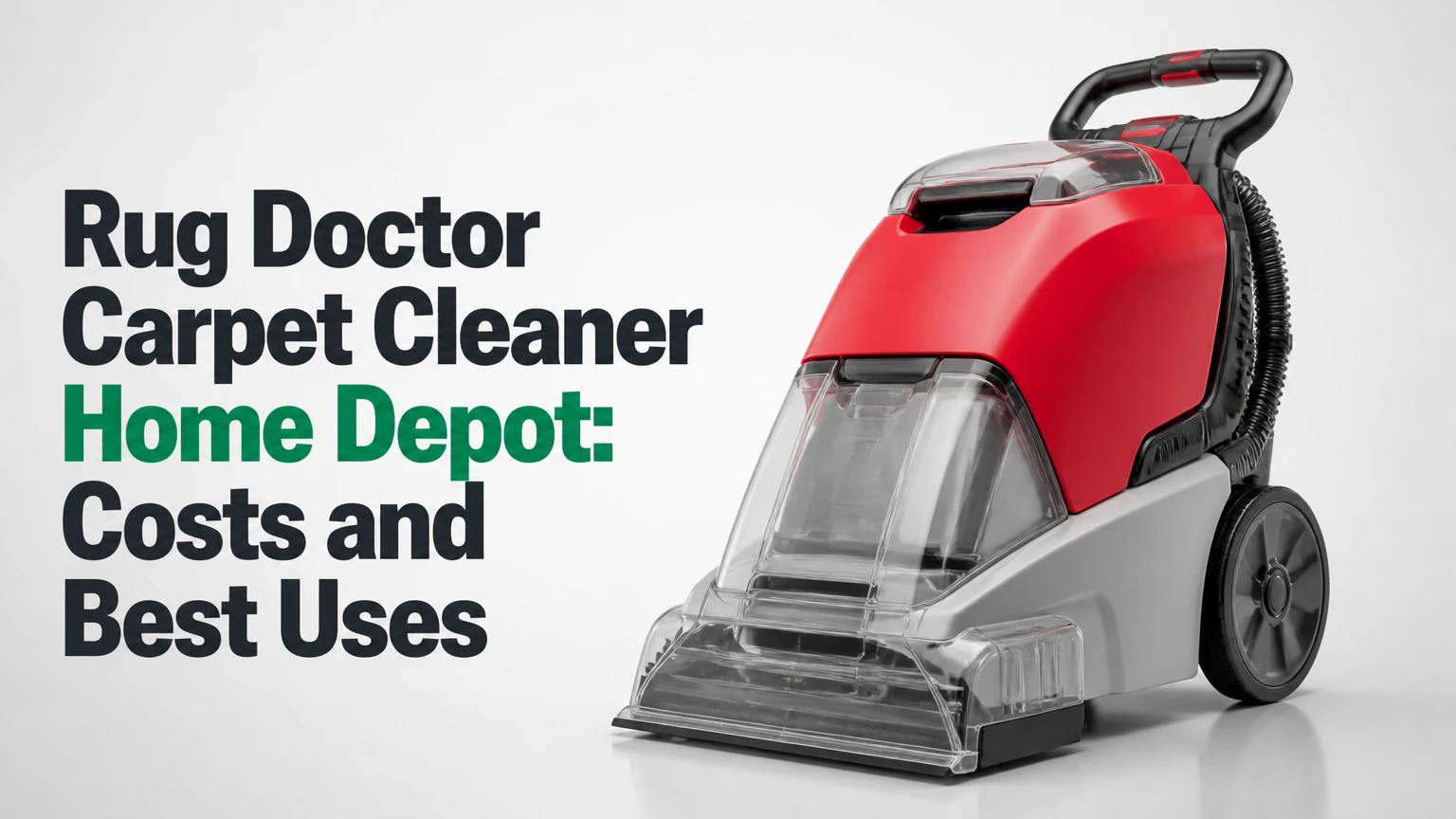
A Rug Doctor carpet cleaner rented from Home Depot is a commercial-style extraction machine for removing embedded soil, pet residue, and stains from suitable carpets. Expect a store-dependent rental price, separate cleaning solution, substantial lifting effort, and roughly 4-24 hours of drying when the machine is operated with slow wet passes and repeated dry passes.
Key Facts at a Glance
- Home Depot rental inventory, pricing, deposits, and attachment options vary by store and must be confirmed through the local Tool Rental Center.
- A realistic typical project budget is about $45-$75 before unusual fees, extra solution, taxes, or transportation costs.
- Rug Doctor cleaning uses three actions: solution injection, brush agitation, and vacuum extraction into a recovery tank.
- The cleanest result usually comes from one controlled wet pass followed by two or more dry passes.
- Carpet should be tested for color bleeding, fiber damage, and backing sensitivity before full-room cleaning.
- A rental machine is economical for several carpeted rooms, but a professional cleaner is safer for delicate fibers, severe urine contamination, or persistent water damage.
What Is a Rug Doctor Rental at Home Depot?
A Home Depot Rug Doctor rental is a self-service carpet extractor intended for short-term residential cleaning. The machine sprays diluted detergent into carpet, agitates soil with a powered brush, and vacuums the dirty liquid into a separate recovery tank. It is closer to a portable commercial extractor than to an ordinary household vacuum.
Home Depot has listed Rug Doctor rental machines, including the Mighty Pro X3, through its Tool Rental catalog, but a product page does not guarantee inventory at every branch. The local store controls availability, pickup timing, model assignment, damage-protection options, and attachment stock. Check the selected store online and call the Tool Rental Center before traveling.
The rental is designed for water-cleanable synthetic carpet and similar surfaces. It is not a universal solution for every rug, hardwood floor, mattress, upholstery fabric, or carpet backing. Rug Doctor’s own rental guidance and machine instructions should take precedence over generic dilution advice because tank layouts, tools, and operating direction differ by model.
What should you verify before pickup?
Confirm five details before paying: the exact machine, rental window, total checkout amount, upholstery-tool availability, and return-cleaning requirements. Ask whether the branch supplies a measuring cup, hose, recovery tank, power cord, and operating instructions, because missing accessories can delay the project.
Bring a vehicle with enough cargo space and a protected loading area. Traditional full-size extractors are heavy and awkward on stairs. A second adult makes loading safer, especially when a recovery tank still contains dirty water.
How Does a Rug Doctor Carpet Cleaner Work?
A Rug Doctor carpet cleaner combines injection, mechanical agitation, and extraction in one pass. The spray system wets the fibers, the brush loosens bonded soil, and the vacuum head removes solution before it can migrate deeply into the pad.
The clean-water tank holds the diluted solution. Pressing the trigger opens the spray system, while moving the machine activates the brush and vacuum components. The recovery tank collects the extracted liquid, lint, hair, and dissolved soil. When the recovery tank reaches its limit, suction can fall sharply or the machine can stop lifting water.
The machine does not remove every stain chemically. Extraction removes suspended soil, but grease, protein, tannin, rust, dye transfer, and urine salts require different pretreatment decisions. Aggressive brushing can also spread a stain or roughen an unstable fiber.
What do wet and dry passes mean?
A wet pass sprays solution while the operator moves at a controlled pace. A dry pass releases the spray trigger and travels over the same path so the vacuum can remove residual moisture. Dry passes are the main control against long drying times and wet padding.
A practical starting pattern is one wet pass followed by two slow dry passes. Add another dry pass when the carpet feels saturated, the recovery stream remains strong, or the room has limited airflow. Repeated wet passes are usually less helpful than better pretreatment and extraction.
Which Machine or Attachment Fits the Job?
The best rental choice depends on room size, carpet pile, transport limits, and whether the job includes stairs or upholstery. A full-size machine suits several open rooms, while a hand tool adds reach but does not replace the main extractor for broad carpeted areas.
Model names and specifications can change by location. Treat the following as a selection framework, not a promise that every Home Depot branch carries every listed unit.
| Equipment | Typical operating format | Best use | Main limitation |
|---|---|---|---|
| Rug Doctor Mighty Pro X3 | Pull-back commercial extractor; large recovery and solution tanks | Multiple open carpeted rooms; high-traffic synthetic carpet | Heavy transport; awkward around furniture and stairs |
| Rug Doctor Pro Deep or TruDeep | Push or pull operation depending on model; smaller household-oriented tanks | Plush residential carpet; rooms with concentrated traffic | More refills; exact Home Depot rental availability varies |
| Upholstery and stair tool | Hand-held spray, brush, and suction head connected to main unit | Stairs, sofa cushions, vehicle seats, edges, and tight corners | Slower coverage; fabric must be tested separately |
| Consumer carpet washer | Lightweight electric appliance; small onboard tanks | Frequent spot cleaning and small rooms | Lower productivity; more passes and refills |
| Professional portable extractor | Technician-operated spray and recovery system | Delicate materials, severe contamination, difficult access | Service minimums and appointment cost |
Does the upholstery tool make sense?
The upholstery attachment is worthwhile when the project includes stairs, several sofa cushions, or a vehicle interior. It is usually unnecessary for a carpet-only job, and the hand tool can leave fabric wetter than expected because its small head concentrates spray in a narrow area.
Use short trigger bursts rather than continuous spraying. Extract each section slowly, then leave cushions standing on edge with airflow around all surfaces. Never saturate a cushion core that cannot be removed and dried.
What Does a Rug Doctor Rental at Home Depot Cost?
A typical one-day rental budget is approximately $45-$75 after a base rental charge, possible protection fee, local tax, and one bottle of detergent. Home Depot’s final price depends on the selected store, rental period, equipment category, attachment, and local fees, so advertised figures should be treated as starting points.
Rug Doctor’s rental information has commonly referenced 24-hour and 48-hour periods, while Home Depot checkout determines the actual local terms. A longer rental can be economical if it avoids rushed work, but it does not improve cleaning quality by itself. A rushed operator can oversaturate carpet within an hour.
| Project component | Typical amount | When it applies | Verification point |
|---|---|---|---|
| 24-hour machine rental | About $39.99 starting price | One-day pickup and return | Home Depot store checkout |
| 48-hour machine rental | About $49.99 starting price | Larger homes or flexible scheduling | Store-specific rental calendar |
| Damage protection | About $4.95 starting figure | If selected or automatically presented | Checkout fee line |
| Rug Doctor solution | About $15-$25 per bottle | Quantity depends on rooms and soil | Label coverage and store shelf |
| Local sales tax | Variable percentage | Every taxable purchase or rental | Store location |
| Card authorization or deposit | Store-dependent | Rental risk-control hold | Tool Rental associate |
The AI Overview’s prices are useful planning figures, but they are not universal Home Depot rates. Home Depot may alter rental prices, protection fees, taxes, deposit rules, and product availability without changing Rug Doctor’s manufacturer guidance.
How much solution and water do you need?
Follow the label on the solution purchased for the rented machine. A commonly cited Rug Doctor mixing instruction is 4 fluid ounces of solution per gallon of hot tap water, but the exact tank capacity and formula can change, so the bottle label and machine instructions control.
Use hot tap water, never boiling water. Boiling water can damage seals, distort some fibers, and increase shrinkage risk. Measure detergent precisely; excess soap leaves surfactant residue that attracts soil after the carpet dries.
How Do You Use the Home Depot Rug Doctor?
Using the machine safely takes about 2-4 hours for several average rooms, excluding furniture moving and drying. The decisive factor is moisture control: vacuum thoroughly, apply limited solution, move slowly, and perform enough dry passes to remove water.
Before You Start
| Requirement | Typical planning value |
|---|---|
| Operating time | 2-4 hours for several rooms |
| Drying time | 4-24 hours |
| Machine budget | $40-$50 starting rental range |
| Solution budget | $15-$25 per bottle |
| Required supplies | Vacuum, measuring cup, towels, gloves, fan |
| Electrical requirement | Standard grounded 120-volt outlet |
| Main prerequisite | Colorfastness and material test |
Step 1: Inspect the carpet and clear the room
Remove small furniture, toys, cords, pet bowls, and loose objects. Place foil or waterproof blocks beneath furniture that must remain, and do not return heavy furniture until the carpet is fully dry.
Test detergent in a hidden corner. Apply a small amount, blot with a white towel, and wait several minutes. Stop if the towel picks up dye, the pile changes texture, or the backing curls.
You will know the room is ready when the floor is free of loose debris and every fragile item has been protected. A common mistake is beginning with furniture still in place, which forces narrow wet patches that dry unevenly.
Step 2: Vacuum slowly in two directions
Use a conventional vacuum to remove dust, hair, grit, and dry pet debris. Make overlapping passes in both directions, concentrating on entrances and wall edges where abrasive particles accumulate.
The extractor is not a substitute for dry vacuuming. Loose soil mixed with cleaning solution becomes a muddy suspension that can clog the vacuum slot and reduce recovery.
You will know vacuuming is adequate when the collection bin shows little new debris after another pass. The common mistake is skipping this step because the carpet appears visually clean.
Step 3: Pretreat stains without flooding them
Apply a compatible pretreatment to traffic lanes and discrete stains, then follow the product’s dwell-time instructions. A 5-10 minute dwell period is typical for some Rug Doctor pretreatments, but keep the area damp rather than soaking the pad.
Blot or lightly agitate according to the label. Enzyme products can help with fresh biological residue, but they do not guarantee removal of old urine salts beneath the carpet.
You will know pretreatment is ready when the stain has remained within its original boundary and the product has had its stated dwell time. The common mistake is using several incompatible chemicals together, which can create residue or dye damage.
Step 4: Fill the tanks with measured solution
Separate the clean-water reservoir from the recovery tank, then add hot tap water and the labeled amount of detergent. Keep the recovery tank empty and correctly seated before starting.
Do not fill beyond the marked line. Do not add household dish soap, laundry detergent, bleach, ammonia, or unapproved degreasers. Those products can foam excessively, leave residue, or damage seals.
You will know the tank is ready when the water level is below the fill limit and the recovery lid, dome, hose, and retaining parts are secure. The common mistake is confusing the clean tank with the dirty-water tank.
Step 5: Make one controlled wet pass
Plug the machine into a grounded outlet and keep the cord behind the cleaning path. Start at the farthest corner, press the spray trigger, and move at the model’s instructed pace without stopping in place.
Pull-back and push-forward directions differ among Rug Doctor models. Read the machine label rather than assuming every red commercial unit operates identically.
You will know the wet pass worked when the carpet looks evenly damp, not glossy or puddled, and the recovery tank receives dirty solution. The common mistake is moving too quickly, which leaves soil behind while still adding water.
Step 6: Make two or more dry passes
Release the trigger and slowly cover the same path. Repeat until the recovery stream decreases and the carpet feels damp rather than saturated.
Dry passes remove water without adding detergent. They often improve the final result more than an additional wet pass because residual moisture carries dissolved soil toward the backing and extends drying time.
You will know extraction is adequate when a clean towel pressed firmly into the carpet shows only light moisture. The common mistake is treating dry passes as optional.
Step 7: Empty the recovery tank and monitor the machine
Stop when the recovery tank reaches its fill line, the machine changes sound, or suction declines. Unplug the unit before removing tanks or clearing a blockage, and dispose of dirty water according to local plumbing and rental instructions.
Large machines can require several empty-and-refill cycles. Never continue operating with a full recovery tank because liquid can reach components that should remain dry.
You will know the machine is functioning normally when spray output remains consistent and extracted water continues entering the recovery tank. The common mistake is ignoring a loss of suction until the carpet becomes visibly wetter.
Step 8: Dry the room and return the equipment
Open windows when outdoor humidity permits, run fans across the carpet surface, and use air conditioning or a dehumidifier in humid weather. Keep pets and foot traffic off the carpet until it is dry.
Rinse the recovery tank, remove lint from the suction path, clean accessible screens, wipe the exterior, and return all attachments. Photograph the equipment at drop-off if the store uses a self-service return process.
You will know the job is complete when the carpet is dry, the room has no sour odor, and the rental unit is visibly free of hair and sludge. The common mistake is returning a dirty machine and risking a cleaning charge or delayed check-in.
How Long Will the Carpet Take to Dry?
Most properly extracted carpet dries in about 4-24 hours, but padding, humidity, airflow, carpet density, and the amount of water applied determine the actual result. Thin synthetic carpet with strong airflow may dry in several hours, while dense pile over absorbent padding can remain damp overnight.
Do not judge dryness only by the surface. Press a white towel into the carpet near seams, doorways, and heavy-traffic areas. If the towel feels cool and damp, continue airflow before replacing furniture.
Which carpets should not be cleaned casually?
Avoid rental extraction on sisal, jute, seagrass, silk, viscose, antique rugs, unstable printed rugs, and carpet with unknown backing unless the manufacturer permits water extraction. Natural plant fibers can brown, shrink, or distort when exposed to water.
Wool requires fiber-specific chemistry, controlled moisture, and careful agitation. A rental machine may physically clean wool while still causing irreversible texture or dye damage. Professional inspection is the safer choice.
Can a Rug Doctor Damage Carpet?
A Rug Doctor can damage carpet when the operator uses excessive water, unsuitable chemicals, aggressive passes, or the wrong machine direction. The most common preventable problems are prolonged dampness, detergent residue, color bleeding, pile distortion, and browning from moisture movement.
Carpet damage is more likely when the backing is old, delaminated, brittle, or already affected by water. Rental extraction cannot repair damaged adhesive, buckled carpet, mold-contaminated padding, or subfloor moisture.
What are the main risk controls?
- Test a hidden area before full cleaning.
- Use the manufacturer’s dilution, not extra detergent.
- Keep the machine moving while spraying.
- Stop if the carpet releases dye or develops a distorted pile.
- Use dry passes and airflow immediately.
- Do not clean over known water damage or mold growth.
A counterintuitive practitioner rule is that cleaner-looking recovery water does not prove the carpet is clean. Soil may remain when pretreatment is inadequate, while excessive water can produce dark recovery water without improving the fiber condition.
Is Renting Better Than Buying or Hiring a Professional?
Renting a Rug Doctor is usually the best value for a one-time cleaning of several rooms with synthetic carpet. Buying becomes more rational for frequent pet accidents or monthly spot cleaning, while professional service is safer for delicate fibers, severe odor, inaccessible furniture, and contamination that reaches the pad.
| Option | Typical cost | Time commitment | Best-fit condition | Important limitation |
|---|---|---|---|---|
| Home Depot Rug Doctor rental | $45-$75 typical project budget | 2-4 hours cleaning; 4-24 hours drying | Several synthetic-carpet rooms | Customer supplies labor and controls technique |
| Consumer carpet washer purchase | $150-$400 typical retail range | Repeated short sessions | Frequent small spills and pet homes | Smaller tanks and slower whole-house coverage |
| Professional portable cleaning | $150-$500+ typical service range | Appointment plus drying | Delicate, heavily soiled, or difficult spaces | Higher minimum charge and less scheduling control |
| Truck-mounted professional cleaning | $200-$600+ typical service range | Technician-managed visit | Large homes and severe soil | Requires vehicle access and professional appointment |
| Spot-cleaning rental or tool | $20-$50 typical short rental | 30-90 minutes | One stain, stair section, or vehicle area | Poor economics for multiple rooms |
The comparison depends on total carpet area, material risk, frequency, and the cost of failure. Consumer Reports has described renting, buying, and hiring as different economic choices rather than declaring one method universally superior.
When should you hire a professional?
Hire a certified cleaner when carpet care instructions require specialized chemistry, when urine odor persists after extraction, or when water has entered the pad or subfloor. A professional can identify fiber type, use stronger recovery equipment, and apply controlled treatments that a rental user may not have.
Professional cleaning is also preferable before a warranty claim. Keep receipts and follow the carpet manufacturer’s maintenance requirements because an unapproved chemical or extraction method can complicate a claim.
What If the Machine Stops Working?
Most Rug Doctor rental failures come from an unseated recovery tank, blocked suction path, disconnected solution coupling, tripped electrical protection, or a full tank. Unplug the machine before inspecting any moving part, hose, filter, or nozzle.
| Symptom | Likely cause | Safe check | Stop-use condition |
|---|---|---|---|
| No power | Tripped GFCI, breaker, or switch | Test another grounded outlet and reset once | Burning odor, sparks, damaged cord |
| No spray | Empty clean tank, blocked jet, loose coupling | Reseat tank and inspect visible connector | Leaking solution near electrical parts |
| Weak suction | Full recovery tank or poor lid seal | Empty tank and reseat dome or lid | Motor pitch changes or liquid reaches motor |
| Wet carpet after passes | Fast movement or too few dry passes | Slow down and repeat dry passes | Water remains after extended airflow |
| Brush not moving | Jammed hair or belt fault | Unplug and remove only accessible debris | Grinding noise or exposed damaged part |
| Bad odor after cleaning | Dirty recovery tank or wet pad | Rinse tank and improve airflow | Sour odor persists after 24-48 hours |
Do not disassemble a rental machine beyond the user-accessible parts described by the store or manufacturer. Contact Home Depot or Rug Doctor support when a fault could involve the motor, belt, electrical system, or internal pump.
Which Situations Change the Recommendation?
A whole-house rental is not automatically the best approach for every cleaning scenario. Room size, access, fabric type, and contamination location change the correct equipment and workflow.
Apartments and move-out cleaning
A Rug Doctor rental can suit a move-out clean when the apartment has several rooms of synthetic carpet and the lease allows tenant-performed cleaning. Reserve enough time for furniture removal, multiple tank cycles, drying, and the return deadline.
Photograph the carpet before and after cleaning. Extraction may improve appearance but cannot remove permanent bleaching, worn traffic lanes, delamination, or old discoloration.
Pet stains and odors
Use an enzyme-compatible pretreatment for fresh biological residue, then extract carefully without flooding the area. Old urine odor often remains because urine salts migrate into padding and subfloor materials beyond the machine’s effective reach.
Black-light inspection can locate missed spots, but it cannot identify every odor source. If smell returns after the carpet dries, stop repeating wet passes and arrange a professional assessment.
Stairs and vehicles
Rent the upholstery or stair tool when the main project includes narrow steps, car seats, or sofa cushions. Work from the upper stair downward, use short sprays, and protect adjacent walls from overspray.
A vehicle needs ventilation and complete cushion drying. Do not close the car immediately after cleaning because trapped humidity can create odor and slow drying.
Common Mistakes and How to Fix Them
Too much detergent
Excess detergent leaves sticky residue that attracts soil. Rinse only when the machine and carpet instructions allow it, then use additional extraction passes without adding solution.
Too much water
Repeated wet passes can drive moisture into padding and seams. Stop spraying, increase airflow, and check the towel test in several locations.
Fast machine movement
Fast passes reduce brush contact and extraction time. Slow the machine enough to keep the recovery head engaged without leaving standing water.
Stain wicking after drying
A stain that reappears often migrated from the backing or pad. Blot the affected area, apply minimal compatible treatment, cover it with a weighted white towel, and extract lightly rather than soaking the entire room again.
Furniture returned too soon
Furniture can trap moisture and transfer dye or rust to damp carpet. Wait until the carpet and furniture feet are dry, then use protective tabs or foil during the first day.
FAQ
Does Home Depot always have a Rug Doctor available?
No. Rug Doctor rental availability is location-specific, and the listed model, rental period, attachment stock, and pickup time can differ between Home Depot stores. Select the exact store in the online rental system, then call the Tool Rental Center to confirm that the machine is physically available before visiting.
Can I use any carpet shampoo in the rental machine?
Use the detergent specified by Rug Doctor or the rental instructions for that machine. Household laundry detergent, dish soap, bleach, and ammonia can create foam, residue, chemical damage, or seal problems. Measure the approved formula precisely because extra soap does not compensate for poor vacuuming or insufficient pretreatment.
Can I walk on carpet after using the extractor?
Limit walking until the carpet is dry, typically 4-24 hours. If necessary, wear clean socks or use clean indoor footwear, avoid moving dirty furniture across damp fibers, and keep pets away. Foot traffic before drying can transfer soil into softened fibers and create uneven drying around compressed areas.
Will a Rug Doctor remove permanent stains?
A Rug Doctor can remove soil and improve many water-safe stains, but it cannot guarantee removal of bleach loss, dye transfer, rust, permanent fiber discoloration, burned fibers, or aged urine damage. Pretreatment chemistry matters more than machine strength for many stains, and aggressive scrubbing can worsen an unstable area.
How many dry passes should I make?
Begin with two slow dry passes after each wet section, then add passes until the carpet feels damp rather than saturated. Dense carpet, humid rooms, and heavily soiled padding may need more extraction. A white-towel test provides a better stopping signal than a fixed pass count.
Should I rent for 24 or 48 hours?
Choose 24 hours for a prepared, single-day project with several open rooms. Choose 48 hours when the home needs furniture moving, multiple tank cycles, stairs, or a second cleaning session. Compare the full checkout total because the longer period may include different protection, tax, or availability rules.
The Bottom Line
A Home Depot Rug Doctor rental is a sensible DIY choice for several rooms of water-safe synthetic carpet when the local store confirms inventory and the operator controls detergent and moisture. Plan on roughly $45-$75 for a typical machine-and-solution project, allow 2-4 hours for cleaning, and reserve 4-24 hours for drying.
The best result comes from preparation rather than repeated soaking: vacuum twice, pretreat selectively, make one measured wet pass, complete multiple dry passes, and clean the machine before returning it. For wool, plant fibers, antique rugs, severe urine contamination, mold, or damaged backing, professional assessment is the safer decision. Use the exact phrase rug doctor carpet cleaner home depot when checking the rental listing, but rely on the selected store’s checkout and instructions for the final facts.