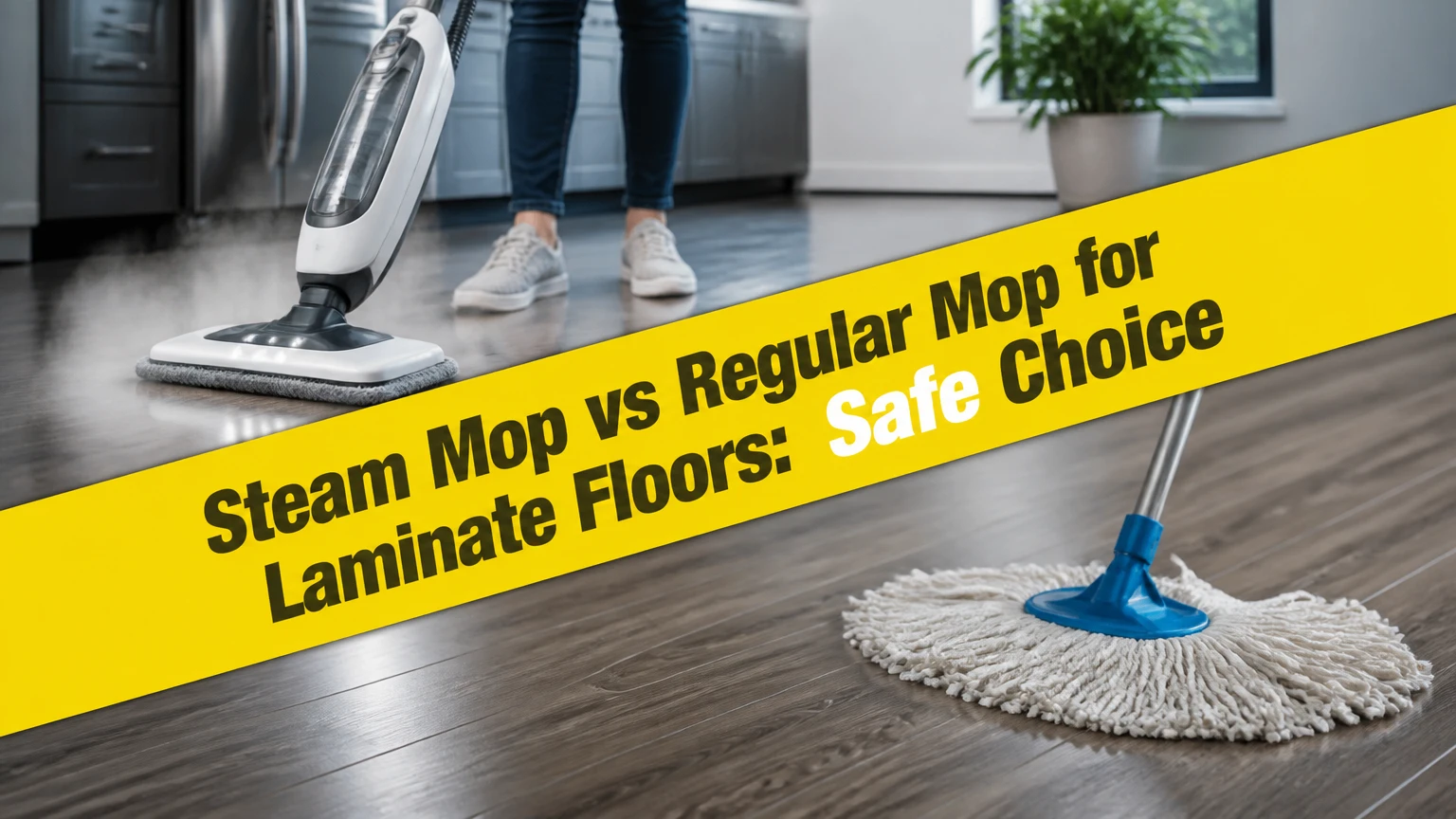
A regular microfiber spray mop is usually safer than a steam mop for laminate floors because it avoids concentrated heat and allows precise moisture control. Use a steam mop only when the flooring manufacturer expressly permits steam cleaning, then use the lowest setting, a clean pad, and continuous motion across intact, sealed seams.
Key Facts at a Glance
- Laminate flooring tolerates damp cleaning better than standing water, saturated mops, or moisture trapped in plank joints.
- A manufacturer-approved steam mop can clean some water-resistant laminate, but “waterproof” does not automatically mean steam-safe.
- A flat microfiber spray mop gives the most predictable control over cleaning liquid without exposing the wear layer to heat.
- Steam temperature at the nozzle can exceed 100°C (212°F), although the floor surface receives less heat through the pad and moving appliance.
- Never add detergent, vinegar, essential oils, or disinfectant to a steam-mop tank unless the appliance manual specifically permits that formulation.
- A buckled or swollen laminate plank usually cannot be restored by drying alone; replacement may be necessary after the core has deformed.
What Each Mop Does
A regular mop removes soil through friction, absorption, and cleaning chemistry. A steam mop uses heated water vapor, a microfiber pad, and heat-assisted loosening. For laminate, the important difference is not simply “wet versus dry”; it is the combination of moisture exposure, heat, dwell time, and pressure at plank seams.
Laminate flooring typically has a wear layer, a printed decorative layer, a high-density fiberboard or composite core, and a balancing layer. The surface can resist everyday abrasion while the core remains vulnerable to water entering through damaged edges, joints, or perimeter gaps.
A regular mop does not inherently protect laminate. A dripping string mop can deliver far more water than a controlled spray mop. Conversely, a lightly misted microfiber pad can clean routine dust and footprints while leaving almost no liquid behind.
Steam also does not automatically sanitize every surface. Claims such as “kills 99.9% of bacteria” depend on the organism, temperature, contact time, pad condition, and the manufacturer’s test method. Household laminate cleaning usually needs soil removal, not hospital-grade disinfection.
Steam Mop vs Regular Mop for Laminate Floors
For most laminate installations, a regular flat microfiber spray mop wins the safety comparison. Steam mops offer faster loosening of greasy or sticky residue, but that advantage is outweighed when the flooring warranty prohibits steam or the planks have open joints, chipped edges, swelling, or an unknown construction.
| Decision criterion | Flat microfiber spray mop | Spin microfiber mop | Steam mop |
|---|---|---|---|
| Typical purchase price | $20-$50 | $25-$70 | $60-$180 |
| Liquid applied per 500 sq. ft. | 6-16 oz | 12-32 oz | 8-16 oz water |
| Typical surface drying time | 1-5 minutes | 3-10 minutes | 30 seconds-3 minutes |
| Heat exposure | Ambient, about 18-25°C | Ambient, about 18-25°C | Pad commonly about 40-70°C while moving |
| Warranty compatibility | Usually accepted, if cleaner is approved | Usually accepted, if barely damp | Often excluded unless expressly approved |
| Main failure risk | Cleaner residue or excess spray | Over-wetting from poor wringing | Heat and vapor entering seams |
| Best use | Routine laminate maintenance | Larger areas with controlled wringing | Approved floors and difficult residue |
The steam-mop temperature requires precision. Water may be heated above 100°C inside the appliance, but the laminate does not necessarily reach the nozzle temperature. A moving microfiber pad spreads and loses heat, while a stationary mop concentrates moisture and thermal energy in one location.
The practical rule is straightforward: choose the lowest-risk method that removes the soil. Routine dust, footprints, and dry food particles do not require steam.
Which Mop Types Fit Laminate?
A flat microfiber spray mop is the strongest default choice for laminate because the trigger applies a measured mist directly ahead of an absorbent pad. The user can spray less liquid near seams, wipe in plank direction, and replace the pad before dirt becomes abrasive.
| Mop type | Typical liquid control | Typical cleaning time for 500 sq. ft. | Laminate suitability |
|---|---|---|---|
| Flat spray mop | 6-16 oz per room | 8-15 minutes | Best routine option |
| Spin mop | 12-32 oz per room | 12-20 minutes | Suitable when thoroughly wrung |
| Flat bucket mop | 1-2 gallons prepared solution | 15-25 minutes | Suitable only when barely damp |
| Cotton string mop | 2-4 gallons retained in head | 15-30 minutes | High swelling risk |
| Steam mop | 8-16 oz tank capacity | 10-18 minutes | Only with written approval |
| Spray-and-vacuum cleaner | 10-20 oz per room | 10-20 minutes | Check manufacturer’s laminate rating |
Spin mops can work well when the basket removes enough water. The test is practical: lift the head after wringing. If water drips or a visible wet trail remains after one pass, the mop is too saturated for laminate.
Traditional string mops are poor choices for this flooring unless a commercial wringer produces a nearly dry head. Their large absorbent volume encourages users to spread a film of water across the floor, especially in kitchens where repeated passes are common.
Steam-and-vacuum combinations reduce loose debris before wet cleaning, but their weight and water delivery vary widely. A machine labeled for hard floors is not automatically approved for laminate, so the manual and flooring warranty remain controlling.
Is Steam Safe on Laminate?
Steam is safe on laminate only when the flooring manufacturer and appliance manufacturer both permit the method. “Water-resistant,” “waterproof,” and “sealed surface” describe different performance claims; none alone proves that repeated high-temperature vapor will not affect the locking system, adhesive, or core.
Check four documents before using steam:
- Flooring care instructions: Search for “steam mop,” “steam cleaner,” and “wet cleaning.”
- Warranty exclusions: Some warranties exclude damage caused by steam, excessive moisture, or unapproved chemicals.
- Installation condition: Inspect seams, chipped edges, swelling, and transitions before cleaning.
- Appliance instructions: Confirm the lowest output mode, approved water type, pad requirements, and prohibited additives.
Pergo, Quick-Step, Mohawk, Shaw, and other flooring brands publish care instructions that vary by product line and market. A recommendation for one collection cannot be transferred to another collection from the same brand.
If approval exists, test the steam mop in a hidden area for one short pass. Wait at least 24 hours and inspect for raised edges, gloss change, whitening, tackiness, or a loosened joint. Do not continue if any defect appears.
How Should You Clean Laminate With a Regular Mop?
Clean laminate with a dry microfiber pass first, followed by a lightly damp, pH-neutral microfiber mop, then remove visible moisture immediately. A 500-square-foot area normally needs about 6-16 fluid ounces of spray solution and 8-15 minutes, depending on furniture and soil.
Step 1: Remove Grit
Vacuum with a hard-floor setting or use a soft dust mop. Remove sand, pet litter, and crumbs before applying liquid because grit under a mop pad can scratch the aluminum-oxide wear layer.
Success checkpoint: The floor has no loose particles in entryways or along baseboards.
Common mistake: Using a rotating brush designed for carpet, which can drag grit across the finish.
Step 2: Prepare the Cleaner
Use a laminate cleaner at the label dilution, or use clean water if the floor has only light dust. Do not guess a stronger concentration. Excess surfactant leaves a film that attracts more soil and creates cloudy streaks.
Success checkpoint: The solution is correctly diluted and the spray bottle contains a labeled mixture.
Common mistake: Combining ammonia, bleach, dish soap, wax, or oil-based polish with laminate cleaner.
Step 3: Control the Moisture
Spray a fine mist over an area of roughly 10-20 square feet, then wipe with a clean microfiber pad. Do not spray directly into joints, under appliances, or against baseboards.
Success checkpoint: The pad feels damp, while the floor has no puddles or glossy wet trails.
Common mistake: Reusing a saturated pad, which redistributes dirty water instead of collecting it.
Step 4: Follow the Planks
Move in the direction of the plank length and use overlapping passes. Work toward an exit so shoes do not track grit over the cleaned surface.
Success checkpoint: Footprints and streaks disappear after one or two passes.
Common mistake: Scrubbing with a stiff pad or abrasive sponge to remove a mark.
Step 5: Dry the Surface
Use a second dry microfiber pad on areas that remain visibly wet. A fan can shorten drying time in humid rooms, but a dehumidifier is more useful after a spill or leak.
Success checkpoint: No moisture remains at seams, transitions, or under cabinet toe-kicks after five minutes.
Common mistake: Leaving the room before checking the perimeter, where liquid accumulates first.
How Should You Use an Approved Steam Mop?
Use an approved steam mop with the lowest output, a clean dry microfiber pad, continuous movement, and no added chemicals. Steam cleaning should be occasional rather than the default routine because vapor can force moisture into joints even when the visible surface dries quickly.
Follow this limited procedure:
- Vacuum the entire area and remove grit.
- Fill the tank with the water specified by the appliance manual. Distilled water reduces mineral deposits, but it does not make steam safe for an unapproved floor.
- Attach a clean, dry pad. A dirty pad spreads soil and can abrade the finish.
- Select the lowest setting or a labeled laminate mode.
- Test an inconspicuous area, then move continuously at roughly 1-2 feet per second.
- Never pause over a seam, transition, stain, or damaged plank.
- Remove the pad after use and inspect the floor for moisture, haze, or joint movement.
Do not put floor cleaner in the tank. Steam-mop manufacturers commonly prohibit additives because detergents can foam, corrode components, leave residue, or aerosolize chemicals.
Which Criterion Matters Most?
Moisture control matters more than raw cleaning power for laminate floors. A mop that removes grease quickly but repeatedly drives vapor into open joints can create a larger repair problem than the original spill.
| Criterion | Regular microfiber mop | Steam mop | Practical winner |
|---|---|---|---|
| Daily dust and footprints | One damp pass | More setup than needed | Regular mop |
| Dried food residue | Cleaner plus 20-30 seconds of dwell time | Heat loosens residue quickly | Steam if approved |
| Water-sensitive or old laminate | No concentrated heat | Vapor can enter weak seams | Regular mop |
| Chemical avoidance | Requires approved cleaner or water | Uses water only | Steam if approved |
| Bacterial reduction | Removes organisms with soil | Heat may reduce surface bacteria | Steam for approved floors |
| Low physical effort | Requires pad changes and wiping | Less scrubbing for sticky soil | Steam if approved |
| Warranty protection | Usually lower risk | Warranty may exclude steam | Regular mop |
| Quiet, cordless operation | Yes | No, electricity required | Regular mop |
Moisture and Seam Protection
A regular spray mop wins moisture control when the user applies a fine mist and changes pads regularly. A steam mop may leave a dry-looking surface while vapor has entered a joint, so rapid evaporation is not proof that the floor received little moisture.
Heat and Finish Protection
A regular mop wins heat safety because it keeps the floor near room temperature. Steam can soften residue and may affect edge treatments, adhesives, or printed layers when the pad stops moving or the floor already has damage.
Cleaning Power
An approved steam mop wins on some dried, greasy deposits because heat reduces the work needed to dissolve them. A regular mop can achieve similar results with a short dwell time, a suitable pH-neutral cleaner, and a nonabrasive microfiber pad.
Hygiene
Steam has a hygiene advantage only under the conditions used in the relevant test, including adequate temperature and contact time. For household floors, removing food residue and pet soil promptly is often more important than pursuing a universal “99.9%” claim.
Cost and Maintenance
The purchase-price difference is usually $40-$130. Regular mops need replacement pads and cleaner, while steam mops need washable pads, electricity, mineral management, and eventual replacement of pumps, seals, or heating components.
| Cost factor | Regular spray mop | Spin mop | Steam mop |
|---|---|---|---|
| Initial tool cost | $20-$50 | $25-$70 | $60-$180 |
| Replacement pad cost | $5-$15 each | $8-$20 each | $10-$25 each |
| Cleaner or water cost per month | $2-$10 | $3-$12 | $1-$5 |
| Typical room cleaning time | 8-15 minutes | 12-20 minutes | 10-18 minutes |
| Typical drying time | 1-5 minutes | 3-10 minutes | 30 seconds-3 minutes |
| Main maintenance task | Wash pads | Wash pads and wringer | Descale only as manual permits |
These figures are typical household ranges, not universal product specifications. A large bucket mop can consume more water, and a commercial steam unit can cost substantially more than the consumer range.
Which Mop Should You Choose?
Choose a Regular Spray Mop for Older Floors
Older, budget-grade, or visibly worn laminate should use a flat microfiber spray mop. Chipped edges, swelling near sinks, and loose click joints create pathways for moisture, so adding steam increases risk without solving the underlying defect.
Choose a Regular Mop for Warranty Protection
Use a regular mop when the warranty excludes steam or the care guide says “damp mop only.” Keep the flooring invoice, product code, and care sheet together because warranty decisions often depend on the exact collection rather than the broad label “laminate.”
Consider Approved Steam for Sticky Soil
A steam mop can make sense for a modern, intact floor whose manufacturer explicitly allows steam. The use case is occasional sticky residue, not routine dusting, and the lowest setting remains the appropriate starting point.
Choose the Lightest Tool for Limited Mobility
A steam mop may reduce scrubbing for someone who cannot press firmly or wring a mop. However, a lightweight spray mop with a long handle and washable flat pad can reduce lifting, heat, electrical-cord handling, and tank maintenance.
Choose Targeted Cleaning for Pets and Children
Pets and toddlers do not automatically require steam. Blot accidents immediately, remove solids with disposable material, clean the affected area with an approved product, and dry the seam. Use a steam mop only if the floor warranty and care guide allow it.
What Should You Use for Specific Messes?
Routine dust requires a dry microfiber dust mop or hard-floor vacuum. Dried food needs a lightly damp cloth held over the spot for 30-60 seconds, followed by gentle wiping; aggressive scraping can damage the wear layer.
| Mess | Recommended method | Liquid amount | Follow-up |
|---|---|---|---|
| Dust and pet hair | Hard-floor vacuum or dry microfiber | 0 oz | Empty vacuum bin |
| Mud tracked indoors | Let dry, vacuum, then damp mop | 1-2 oz per 20 sq. ft. | Dry seams |
| Greasy footprint | pH-neutral cleaner on microfiber | 1-2 sprays | Buff with dry pad |
| Dried food | Damp cloth dwell, then wipe | 1-2 teaspoons | Repeat once |
| Pet urine | Blot, approved cleaner, dry immediately | Minimum needed | Inspect joint |
| Nail polish or paint | Spot-test manufacturer-approved solvent | Few drops on cloth | Never pour on floor |
| Flood or appliance leak | Extract and ventilate immediately | No added water | Contact installer if swelling appears |
Avoid vinegar as a default laminate cleaner. Acidic mixtures can conflict with finish and warranty guidance, and a vinegar solution should not be placed in a steam tank. For an unknown stain, identify the substance first and follow the flooring manufacturer’s spot-cleaning instructions.
What Mistakes Damage Laminate?
The most damaging mistake is not choosing the “wrong” mop category; it is allowing moisture or heat to remain concentrated at a vulnerable joint. The following failures account for many preventable floor problems.
- Leaving a steam mop stationary: A paused hot pad concentrates heat and moisture. Keep the head moving and unplug the unit before stopping.
- Using a saturated string mop: Excess water can enter tongue-and-groove joints and swell the fiberboard core.
- Adding chemicals to a steam tank: Additives may damage the appliance and create airborne residue. Use only the permitted water.
- Using abrasive pads: Scouring pads and stiff brushes can scratch the clear wear layer.
- Mopping before vacuuming: Grit becomes a rubbing compound under the pad.
- Applying wax or oily polish: Laminate generally has a factory finish; wax can create slipperiness, buildup, and difficult recoating.
- Ignoring damaged edges: Cleaning cannot repair swollen, delaminated, or separated planks.
One practitioner rule is worth remembering: if a floor cannot dry within five minutes after a controlled damp pass, reduce the liquid before changing the cleaner. Slow drying usually indicates too much solution, poor ventilation, a saturated pad, or moisture trapped at the perimeter.
How Do You Fix Cloudy or Streaky Laminate?
Cloudy laminate usually results from cleaner residue, mineral deposits, or a dirty microfiber pad rather than a lack of scrubbing. Stop adding product, vacuum loose particles, and wipe a small test area with a barely damp microfiber cloth using the flooring manufacturer’s approved cleaning method.
Use a clean, dry pad for the final buff. Do not pour vinegar, bleach, ammonia, or undiluted solvent onto the floor, and do not assume a homemade mixture is compatible with every wear-layer finish.
If cloudiness remains after residue removal, the surface may have been chemically altered or scratched. Compare the affected area with an unused plank or contact the flooring supplier before applying polish.
How Do You Respond to Buckling or Swollen Edges?
Stop wet cleaning when laminate edges buckle, cup, or rise. Remove standing water, blot without spreading it, improve air movement, and document the affected area before attempting further treatment.
A fan can help surface moisture evaporate, while a dehumidifier is useful in a humid room. Do not force planks flat, inject adhesive, sand the wear layer, or use high heat from a hair dryer. Swollen fiberboard generally does not return to its original dimensions.
If the deformation followed a leak, identify and repair the source first. A flooring installer can determine whether individual click planks can be replaced or whether moisture reached the underlayment.
Why Does a Steam Mop Sputter?
A sputtering steam mop commonly has mineral scale, an empty or incorrectly seated tank, a blocked nozzle, or a saturated pad. Follow the appliance manual’s descaling procedure rather than improvising a vinegar flush, because some manufacturers prohibit acids or specify a proprietary descaler.
| Symptom | Likely cause | Safe first action | Escalation point |
|---|---|---|---|
| Weak steam | Scale or low water | Check tank and manual | Descale as directed |
| Brown droplets | Dirty reservoir or nozzle | Stop on flooring and inspect | Replace or clean pad |
| No steam | Power, tank, or heater fault | Unplug and reseat tank | Service if unresolved |
| Wet streaks | Saturated pad | Install a clean dry pad | Check floor approval |
| Odor | Residue or overheated pad | Turn off and ventilate | Contact manufacturer |
Never operate a malfunctioning steam mop on laminate. Brown droplets, leaking tanks, or erratic heat create a localized damage risk that a normal cleaning pass cannot control.
FAQ
Can I use a Swiffer-style spray mop on laminate?
A Swiffer-style flat spray mop is generally suitable when the pad is microfiber or laminate-safe, the spray is light, and the manufacturer permits the cleaner. Avoid soaking the floor, spraying into seams, or leaving disposable pads saturated. A controlled mist is safer than a wet bucket-mop pass.
Is a spin mop better than a steam mop for laminate?
A properly wrung spin mop is usually safer than a steam mop because it avoids concentrated heat and can remove visible dirt with limited water. A spin mop becomes risky when the head drips or leaves wet trails. Moisture control, not the bucket mechanism, determines the result.
How often should laminate floors be mopped?
Most homes need damp mopping once weekly or when soil appears, with dry dust removal several times each week. Entryways, kitchens, pets, and rainy weather may require more frequent spot cleaning. Frequent wet passes do not improve a floor if each pass leaves excess moisture.
Can I use a steam mop on waterproof laminate?
Waterproof laminate may tolerate spills longer than standard laminate, but the term does not automatically authorize steam cleaning. Confirm the exact product’s care guide and warranty. If steam is not expressly allowed, use a barely damp microfiber spray mop instead.
Should I use hot water with a regular mop?
Use room-temperature or mildly warm water unless the floor-care instructions specify otherwise. Hot tap water does not provide the controlled heat of steam, but it also does not improve cleaning enough to justify excess moisture. The mop head should be damp, never dripping.
What is the safest alternative to both mops?
A hard-floor vacuum followed by a barely damp microfiber cloth is the safest low-moisture alternative for small areas. For daily maintenance, dry microfiber removes dust without water, while targeted spot cleaning limits liquid to the exact location of the soil.
The Bottom Line
For most homes, a regular microfiber spray mop is the better choice for laminate floors because it provides low-moisture cleaning without heat, electrical equipment, or common steam-related warranty problems. A steam mop can be acceptable only when the exact flooring product permits steam and the operator uses low output, a clean pad, continuous movement, and immediate inspection.
The best decision in steam mop vs regular mop for laminate floors is therefore based on the flooring care document, seam condition, and cleaning task. Choose the regular spray mop for routine maintenance and unknown or aging floors; reserve approved steam cleaning for occasional stubborn residue on intact laminate.