
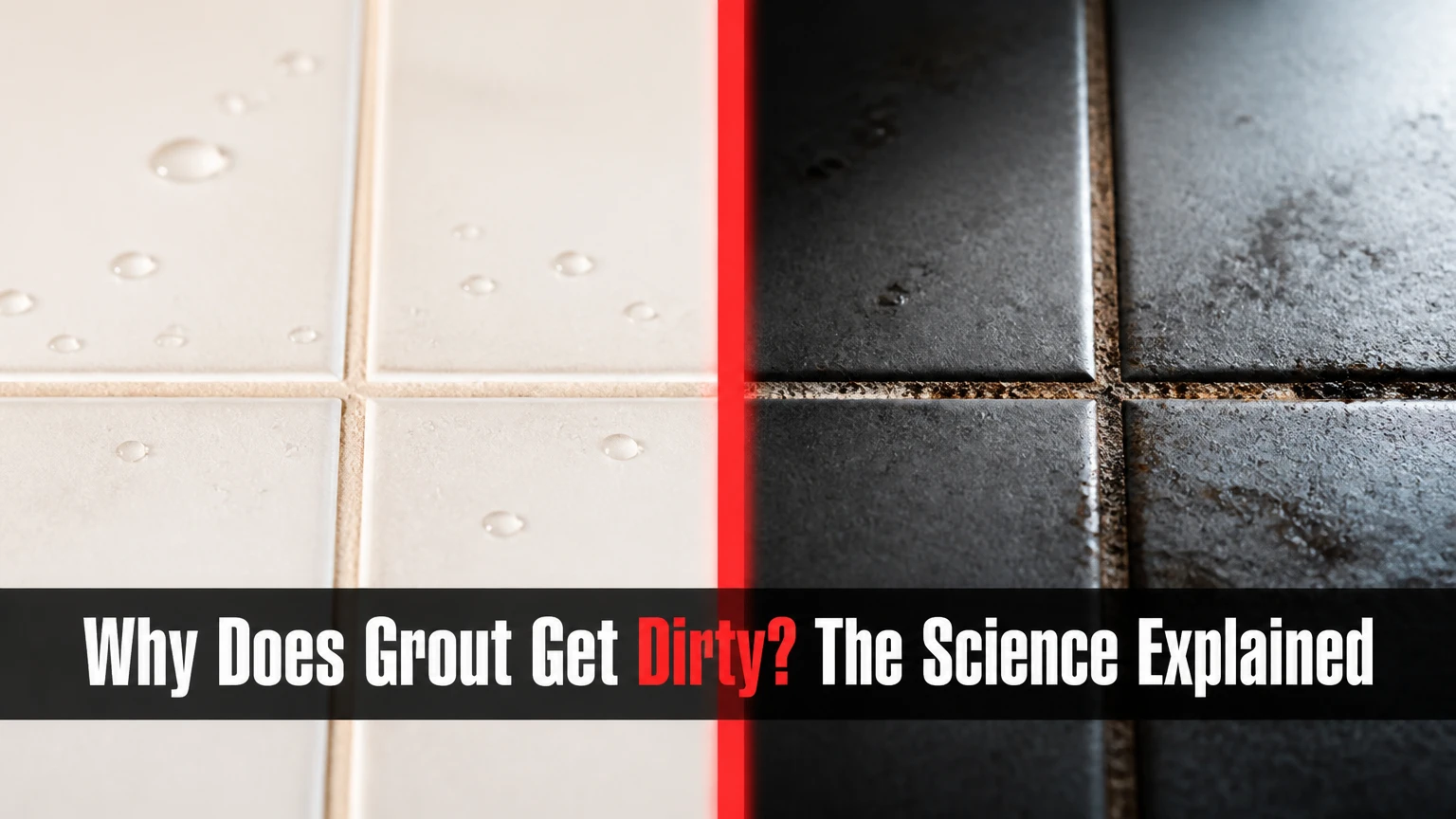
Grout gets dirty because cementitious grout is porous, textured, and slightly lower than the tile surface, so it absorbs liquids and traps soil that tile sheds. As water evaporates, dirt, oils, soap residue, minerals, and microorganisms remain in the joint, where repeated traffic and moisture darken the grout.
Key Facts at a Glance
Standard cement grout contains microscopic pores that can absorb water and dissolved soil.
Recessed grout joints collect particles from shoes, mop water, soap, and airborne dust.
Penetrating sealer reduces absorption but does not create a waterproof surface or stop surface dirt.
Black grout may contain mold, but it may also be embedded soil, grease, or deteriorated material.
Epoxy and urethane grouts resist staining better than ordinary cement grout, but installation and cleaning still matter.
Crumbling, recurring dampness, and open cracks indicate a grout or tile-assembly problem rather than ordinary dirt.
What Is Grout, and Why Is It Vulnerable?
Grout is the material packed into the joints between tiles. Cementitious grout contains cement, aggregate, pigments, and water; epoxy grout uses resin and hardener; premixed urethane or acrylic products use polymer binders with aggregate.
Grout supports tile edges and helps keep debris out of joints, but ordinary grout is not the same as a waterproofing membrane. The waterproof layer in a shower may be a sheet membrane, liquid-applied membrane, or properly built receptor beneath the tile. Grout alone cannot compensate for a failed substrate or missing drainage plane.
Cement hydration creates a rigid mineral structure with connected capillaries. Aggregate size, water content, curing conditions, joint width, and finishing technique affect the final pore network. Excess water during mixing or cleanup can leave a weaker, more absorbent joint.
Tile usually has a smoother, less absorbent glazed surface. Grout has a rougher texture and a larger exposed area relative to its width. That difference explains why a floor can look clean across the tile faces while the joints remain gray or brown.
Why Does Grout Absorb Dirt?
Cement grout absorbs dirty liquid through capillary action, then retains nonvolatile material after the liquid evaporates. Water can carry dissolved salts, coffee pigments, cooking oils, soil particles, detergent residue, and organic compounds into the joint before evaporation leaves those contaminants behind.
A grout sealer changes the rate and depth of absorption, but it does not erase the pore structure. A penetrating sealer occupies or modifies some pathways while leaving the surface appearance mostly unchanged. Sealers also wear unevenly in traffic lanes and can require renewal according to the product label and absorption test.
Grout porosity varies widely. Factory-controlled high-performance cement grouts generally resist staining better than basic site-mixed products, while epoxy grout has much lower water absorption after full cure. No grout is immune to surface soil, pigment transfer, abrasive dust, or poor cleaning.
How does capillary soiling happen?
The process usually follows three stages:
- Contact: Dirty water, oil, food, body soil, or shampoo touches the joint.
- Migration: Absorbent grout pulls part of the liquid into connected pores.
- Residue: Water evaporates, but suspended particles, oils, dyes, and salts remain.
A damp mop can repeat the cycle across an entire floor. A single bucket becomes progressively dirtier, and each pass redeposits soil. Grout absorbs the wet residue more readily than glazed tile, so the joint becomes the visible record of the cleaning water.
Why Does Grout Look Dirtier Than Tile?
Grout looks dirtier than tile because recessed joints collect particles while tile surfaces release much of that soil during wiping. The joint profile creates a small “valley,” and mop fibers, shoes, pet traffic, and gravity move loose debris toward the lower line.
The effect is strongest on textured tile, floors with wide joints, and surfaces cleaned with excessive water. A microfiber mop can remove soil from the tile face yet push a damp film into the joint. Rinsing the mop frequently and using limited solution reduces that transfer.
Light-colored grout also creates a stronger visual contrast. A small amount of gray soil is obvious against white grout, whereas the same contamination may be difficult to see on medium-gray or tan joints. Color can reduce visible contrast, but it does not eliminate contamination.
Which areas soil grout fastest?
| Area | Main soil source | Typical visible pattern | First control |
|---|---|---|---|
| Kitchen floor | Cooking grease, food, tracked soil | Gray-brown joints near sink and range | Remove grease before mopping |
| Bathroom floor | Body soil, hair products, dust | Gray lines around toilet and doorway | Vacuum, then damp-mop |
| Shower wall | Soap film, oils, minerals | Dark, pink, or orange patches | Rinse and dry after use |
| Entryway | Grit, mud, de-icing salts | Dark traffic lanes | Use mats and frequent vacuuming |
| Laundry room | Detergent, lint, hard-water residue | White or dull chalky joints | Control overflow and rinse residue |
What Causes Grout to Turn Black, Pink, or Orange?
Black grout can result from embedded soil, grease, mold, or a combination of these contaminants. Pink or orange film in a shower commonly indicates microbial growth associated with moisture and soap residue, although rust, cosmetic dyes, and mineral deposits can produce similar colors.
Serratia marcescens is frequently associated with pink bathroom film. The color alone does not prove a particular organism, and black discoloration does not automatically identify Aspergillus or another mold species. A laboratory test is required for species identification.
Persistent growth requires more than a stronger cleaner. Reduce the conditions that support it: remove soap film, improve exhaust ventilation, dry horizontal ledges, repair leaks, and keep joints free from standing water. Porous cement grout can retain discoloration even after organisms on the surface are removed.
How can color help identify the soil?
| Grout appearance | More likely causes | Useful confirmation | Appropriate response |
|---|---|---|---|
| Uniform gray-brown | Dust, mop soil, shoe traffic | Darkest in walk paths | Vacuum and use a suitable alkaline cleaner |
| Black speckles or patches | Mold, embedded soil, deteriorated joint | Concentrated in damp corners | Clean, dry, and investigate recurring moisture |
| Pink or salmon film | Soap residue and microbial biofilm | Slimy surface in shower | Remove residue and improve ventilation |
| Orange or rust-colored | Iron deposits, metal corrosion, dyes | Near fixtures or hard water | Identify source before choosing cleaner |
| Chalky white | Efflorescence, grout haze, mineral scale | Powder or crystals after drying | Brush dry first and identify the deposit |
Which Grout Types Resist Dirt Best?
Epoxy grout generally resists liquid staining and water absorption better than cement grout, while urethane and high-performance cement grouts offer intermediate performance. Standard sanded and unsanded cement grouts remain more dependent on correct curing, cleaning, sealing, and routine maintenance.
| Grout type | Typical joint or use | Water and stain resistance | Main limitation |
|---|---|---|---|
| Sanded cement | Floors and joints about 3 mm or wider, product-dependent | Moderate to low without sealer | Rough pores collect soil |
| Unsanded cement | Narrow joints and delicate tile surfaces | Low to moderate without sealer | Cement remains absorbent |
| High-performance cement | Kitchens, bathrooms, commercial floors | Moderate to high after cure | Still needs correct maintenance |
| Epoxy | Wet areas, kitchens, demanding installations | High after full cure | Costly and technique-sensitive |
| Urethane or acrylic premix | Residential floors and walls | Moderate to high | Product-specific cure and chemical limits |
“Epoxy is maintenance-free” is an overstatement. Epoxy grout does not normally need a penetrating sealer, but soap film, mineral scale, abrasive grit, and grout haze can still accumulate on its surface. Some epoxy products also require prompt residue removal during installation because cured haze is difficult to correct.
Cement grout remains a reasonable choice where cost, appearance, repairability, and traditional installation matter. The best material depends on joint width, tile type, movement, chemical exposure, installer skill, and the assembly’s moisture design.
How Should Dirty Grout Be Cleaned?
Dirty grout should be cleaned by removing dry grit first, selecting chemistry for the soil, agitating with nylon, and rinsing without flooding the joint. A small test area should be completed before treating the entire installation, especially when tile is natural stone or grout color is uncertain.
Step 1: Remove loose soil
Vacuum or sweep with a soft tool before adding water. Grit left on the floor can become abrasive slurry during mopping and may scratch polished tile or settle into grout texture.
Step 2: Identify the contaminant
Use a neutral or mildly alkaline tile cleaner for ordinary soil. Grease and soap film usually respond better to an alkaline cleaner than to vinegar. Mineral scale and cement haze may require an acid formulated for the specific tile and grout, but acids can damage cement grout and calcareous stone.
Step 3: Apply a controlled amount
Work in sections of roughly 0.5-1 square meter. Keep the cleaner wet for the label-specified dwell time, commonly 5-10 minutes, without allowing it to dry. Dwell time helps chemistry loosen soil before scrubbing.
Step 4: Agitate with nylon
Use a medium nylon grout brush or a suitable powered brush. Avoid steel or wire bristles, which can gouge cement joints, scratch metal trim, and dislodge weak grout.
Step 5: Extract and rinse
Lift the dirty solution with a towel, wet vacuum, or clean microfiber system. Rinse with clean water and change the rinse water when it becomes visibly cloudy. Flooding spreads dissolved soil into adjacent joints.
Step 6: Dry and reassess
Allow the surface to dry fully, often 12-24 hours depending on ventilation and humidity. Remaining color may be permanent staining, efflorescence, microbial discoloration, or grout failure rather than removable surface dirt.
Which cleaner matches each soil?
| Soil type | Cleaner category | Typical dwell time | Important restriction |
|---|---|---|---|
| Dust and tracked soil | Neutral pH tile cleaner | 5-10 minutes | Rinse when residue remains |
| Grease and body oil | Mild alkaline tile cleaner | 5-15 minutes | Test pigments and delicate finishes |
| Soap film | Alkaline or manufacturer-approved bathroom cleaner | 5-10 minutes | Do not mix with chlorine products |
| Mold or biofilm | Labeled antimicrobial cleaner | Product-specific | Ventilate and follow label directions |
| Hard-water scale | Compatible acidic descaler | 1-5 minutes | Avoid marble, limestone, and weak cement grout |
| Efflorescence | Dry brushing, then specialty treatment | 5-10 minutes if treated | Find the moisture source |
Does Sealing Keep Grout Clean?
Sealing reduces liquid penetration into absorbent cement grout, but it does not prevent surface dust, soap film, or traffic soil from collecting. Grout should be thoroughly cleaned, fully dried, and confirmed compatible before sealing; applying sealer over contamination can preserve the stain beneath the treatment.
A penetrating sealer is usually invisible and preserves a natural finish. It helps slow absorption but does not form a waterproof coating. A color sealer applies a pigmented protective layer and can restore uneven color, although poor surface preparation can lead to adhesion failure or visible wear.
Test absorption rather than relying on a calendar. After grout has cured according to the manufacturer’s instructions, place a few drops of water on a clean, dry joint. If the water darkens the grout or absorbs promptly, the joint may benefit from compatible sealing. The test is not suitable for every product, so the label controls.
How often should grout be resealed?
Typical residential cement grout may need resealing every 1-3 years in heavily used wet or floor areas, while lightly used walls may go longer. Traffic, cleaner chemistry, water hardness, joint porosity, and sealer formulation create wide variation.
Epoxy grout generally does not require penetrating sealer. Sealing epoxy can create residue or an unwanted film unless the product manufacturer specifically permits it.
Which Cleaning Mistakes Make Grout Worse?
The most damaging routine mistakes are repeated acid use, excessive bleach, metal-bristle scrubbing, detergent residue, and sealing before cleaning. These practices can enlarge pores, weaken joints, leave sticky films, or trap discoloration.
- Frequent vinegar or lemon use: Acid can etch cementitious grout and some tile surfaces. A diluted, occasional application is not equivalent to repeated concentrated exposure.
- High-strength bleach: Chlorine can discolor pigments and damage surrounding materials. It also does not remove mineral scale or greasy soil.
- Dish soap on floors: Surfactants and fragrance ingredients can leave a film that attracts dust.
- Metal brushes: Steel scratches and removes the cement-rich surface.
- Excess water: Dirty liquid can migrate deeper into porous joints.
- Sealing dirty grout: Sealer protects the existing surface condition; it does not reverse embedded staining.
A counterintuitive practitioner rule is to use less water, not more, when grout is dirty. Controlled application, mechanical agitation, extraction, and a clean rinse usually outperform a saturated floor.
Is the Problem Dirt, Efflorescence, or Grout Failure?
White powder, recurring dampness, and crumbling grout indicate different problems from ordinary surface soil. Cleaning can remove loose contamination, but it cannot repair a weak joint, stop substrate movement, or correct water traveling through an improperly built assembly.
Why does grout turn white?
Efflorescence occurs when moisture dissolves soluble salts in the setting materials or substrate, transports them toward the surface, and leaves crystals after evaporation. Grout haze is different: haze is a thin cement or polymer residue left on tile after installation.
Brush loose white crystals with a dry nylon brush first. Repeated wet cleaning can dissolve and redeposit the salts. If efflorescence returns, inspect drainage, moisture entry, slab conditions, and the shower waterproofing system.
What does powdery grout mean?
Powdery grout usually indicates weak material, excessive mixing water, premature drying, poor compaction, contamination, or prolonged deterioration. If grout transfers to a finger after drying or can be scraped away easily, surface cleaning is unlikely to provide a durable repair.
Remove structurally compromised joints to the manufacturer’s required depth without damaging tile edges, then install compatible replacement grout. Recurring cracks at corners or long straight runs may indicate movement, missing movement joints, or substrate deflection.
When is dirty grout a moisture warning?
Dirty grout deserves a moisture investigation when discoloration returns quickly after cleaning, dampness persists beyond normal drying, tiles sound hollow or move, or stains extend upward from below. A shower should be evaluated by a qualified tile or waterproofing professional when leakage may affect framing or adjacent rooms.
How Can Dirty Grout Be Prevented?
Dirty grout stays cleaner when loose soil, liquid residue, and organic film are removed before they enter or remain in the joints. The most effective routine combines entry mats, dry soil removal, low-residue cleaning, ventilation, prompt spill treatment, and periodic inspection.
For a typical family kitchen or entryway:
- Vacuum high-traffic areas at least twice weekly.
- Place absorbent mats inside and outside exterior doors.
- Blot spills promptly instead of spreading them with a wet mop.
- Use a neutral tile cleaner at the label dilution.
- Rinse microfiber pads frequently.
- Keep pets’ outdoor dirt and road salt off the floor.
- Inspect grout every 6-12 months for cracks, darkening, and absorption.
For showers, squeegee or towel surfaces after use, run the exhaust fan during the shower and for about 20 minutes afterward, and keep bath products off horizontal ledges. Ventilation reduces drying time, but it does not replace leak repair.
How Much Do Cleaning and Repair Cost?
Typical US residential costs range from about $0.75-$3.50 per square foot for professional cleaning, $2-$6 per square foot for color sealing, and $8-$20 per square foot for removal and regrouting. Local labor, access, tile condition, joint width, furniture, and hazardous-material requirements can change those figures substantially.
| Service | Typical US price | Typical time | Best use |
|---|---|---|---|
| DIY cleaner and brush | $15-$60 materials | 2-6 hours | Surface soil and routine buildup |
| Professional cleaning | $0.75-$3.50/sq. ft. | 3-8 hours | Large or heavily soiled areas |
| Penetrating sealer | $0.50-$2/sq. ft. DIY materials | 1-2 days including cure | Absorbent, sound cement grout |
| Color sealing | $2-$6/sq. ft. | 1-2 days | Uneven color and cosmetic restoration |
| Regrouting | $8-$20/sq. ft. | 1-4 days | Crumbling, open, or failed joints |
Professional cleaning is a poor investment when grout is structurally soft, the shower leaks, or contamination returns because moisture remains below the tile. Regrouting is also inappropriate if movement or waterproofing defects have not been addressed.
FAQ
Can dirty grout be permanently restored?
Grout can often be restored cosmetically, but “permanent” depends on the cause. Surface soil may clean completely, while dye, rust, efflorescence, and deep microbial staining can remain. Color sealing changes appearance and adds a protective layer, but movement, leaks, and recurring moisture must be corrected first.
Does steam cleaning remove grout dirt?
Steam can loosen surface soil and some organic residue, especially when followed by extraction. Steam cannot remove every absorbed stain, repair weak grout, or correct a leaking shower. Excessive heat or pressure may damage sealers, soften some polymer products, or force moisture into vulnerable joints.
Can baking soda clean cement grout?
Baking soda can provide mild abrasion and alkaline cleaning for light surface soil, but it is not a complete treatment for grease, mineral scale, or deep staining. Apply a compatible paste gently, rinse thoroughly, and test first because residue left in textured grout can attract additional dirt.
Why does new grout get dirty quickly?
New grout may darken quickly because it was overwatered, incompletely cured, cleaned with dirty rinse water, left unsealed when sealing was appropriate, or exposed to soil before the manufacturer’s cure period ended. Confirm the product’s cure time and avoid aggressive chemicals during early curing.
Should grout be white or a darker color?
Darker grout hides visible traffic soil better, while white grout makes contamination easier to detect and can brighten a room. Color does not determine porosity or hygiene. Choose a compatible grout formulation first, then select a color that suits maintenance tolerance, tile contrast, and expected traffic.
Why does grout get dirty again after cleaning?
Grout gets dirty again when the contamination source remains, such as oily soil, detergent film, hard water, poor ventilation, or a damp substrate. A sealer cannot stop surface deposition. Repeated rapid discoloration calls for source control and an inspection rather than increasingly aggressive chemicals.
The Bottom Line
Why does grout get dirty? Cement grout absorbs contaminated liquids, recessed joints collect loose soil, and evaporation leaves oils, pigments, minerals, soap, and organic residue behind. Clean according to the contaminant, use controlled moisture and nylon agitation, seal only sound and clean cement grout, and investigate recurring discoloration, white deposits, dampness, or crumbling before treating the problem as ordinary dirt.